

The latest State of FinOps Report underscores key priorities for practitioners over the next year, and it’s clear that FinOps is undergoing a massive shift. That shift is being driven by two major forces: the rise of AI across FinOps, from managing AI infrastructure costs to using AI to surface insights and automate workflows, and the expansion of FinOps beyond public cloud reporting toward a broader, more operational discipline focused on total technology investment, proactive optimization, and value realization.
What stands out across the report is the growing influence of FinOps. Teams reporting into the CTO/CIO and engaging directly with executive leadership are shaping technology decisions earlier in the lifecycle, from architecture choices to AI investment strategy. FinOps is no longer just measuring spend after the fact. It’s increasingly influencing how and where technology dollars are allocated.
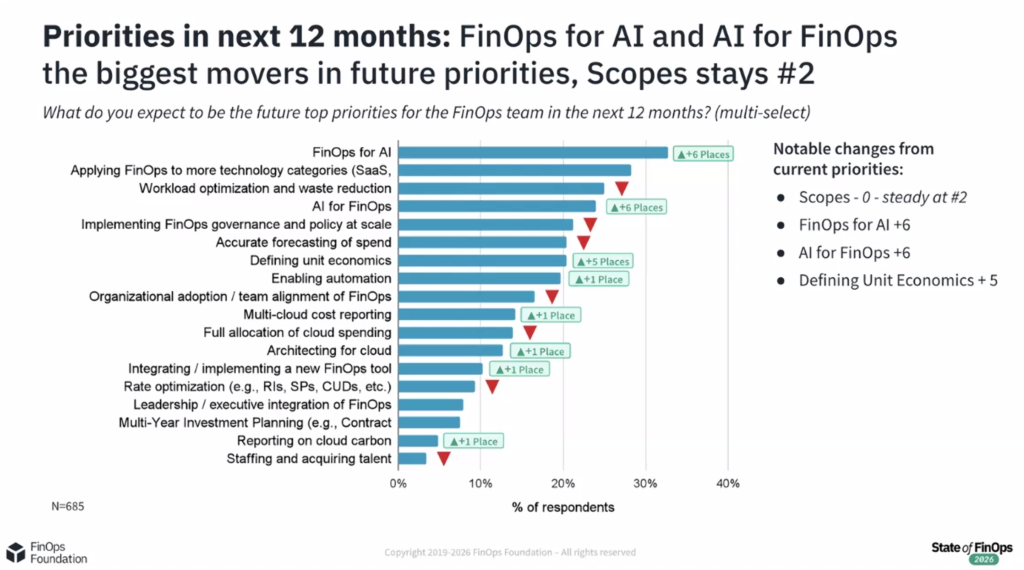
Top 5 Takeaways from the State of FinOps 2026 Report:
1. FinOps for AI: Managing AI Infrastructure Costs
AI cost management has officially moved from an emerging concern to required competency.
The survey shows that AI cost management is now one of the most required skills for FinOps teams. In fact, 98% of respondents report managing AI spend in some form, making it a normal part of business operations rather than a future initiative.
What’s especially interesting is how closely this ties to another rising priority: unit economics. As AI workloads grow, simply tracking spend isn’t enough. Practitioners need to understand the value generated per model, per use case, per workload. Unit economics, paired with governance policies for AI, will be critical to ensuring organizations are not just spending on AI, but optimizing it for measurable outcomes.
AI is no longer experimental. It’s operational, and FinOps will play a central role in managing its financial and strategic impact.
2. AI for FinOps: Automating Forecasting, Insights, and Workflows
While managing AI costs is critical, the survey also highlights growing interest in using AI to enhance FinOps itself.
49% of respondents consider AI for FinOps a high priority, with large enterprises leading this trend. Even more compelling: 81% of respondents are actively exploring how AI can improve FinOps efficiency. This signals that AI is no longer viewed solely as a cost to govern, but as a capability to leverage.
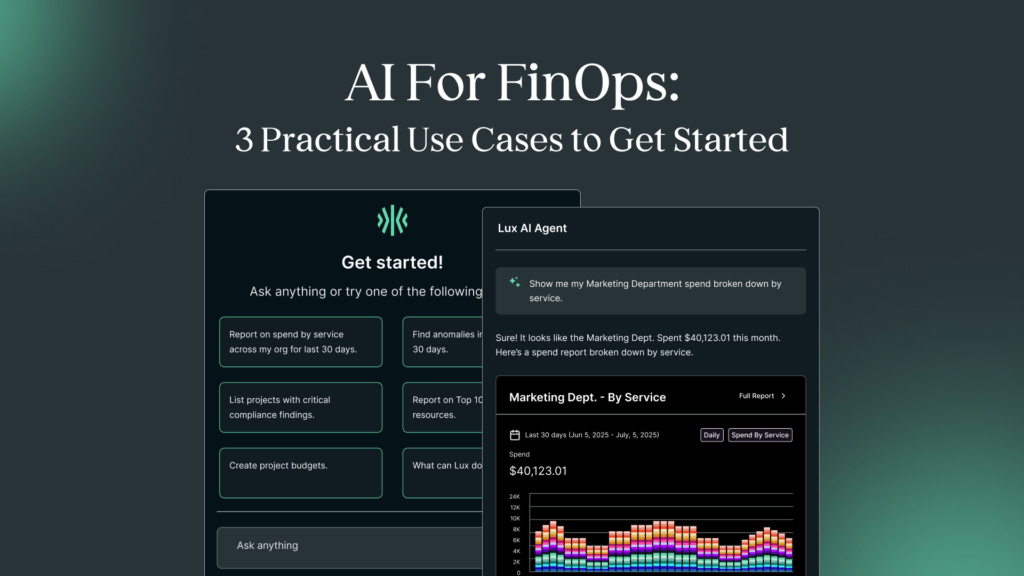
Teams are clearly looking to AI to automate workflows, improve forecasting, surface insights faster, and reduce manual effort. This may be the fastest-evolving priority in 2026. As noted in our prediction blog, the early phase may be noisy while teams identify meaningful use cases — but by the end of the year, we expect to see practical applications that drive real, measurable value across FinOps teams.
AI is both the new cost center and the new accelerator.
3. Implementing Governance and Policy at Scale
Governance ranked as the third overall priority, and that positioning signals a meaningful shift in how practitioners view the future of FinOps.
Optimization and waste reduction remain important, but practitioners are recognizing that attacking waste alone isn’t sustainable without policy and governance at scale. To keep up with growth, maximize value, and maintain control across increasingly complex environments, organizations need guardrails, not just dashboards.
The survey also reflects growing interest in pre-deployment FinOps capabilities. This is effectively a form of “shift-left” financial management: addressing cost and policy earlier in the lifecycle before spend even materializes. Proactive guardrails and automated governance are how teams prevent waste instead of chasing it. It’s worth watching to see how this area continues to evolve, and how Kion can better serve shift-left needs.
Governance is becoming the mechanism that makes optimization scalable.
Note: Last month we released our 2026 FinOps Predictions blog, and today’s survey results include some interesting alignment.
4. Beyond Cloud FinOps
FinOps is definitively moving beyond public cloud.
AI and SaaS are now essentially table stakes. But the survey also shows that more than half of practitioners plan to manage licensing and private cloud over the next 12 months.
FinOps is expanding across the full spectrum of technology investment. Practitioners increasingly expect unified visibility and governance across SaaS platforms, AI services, licensing models, data platforms, and private cloud. As organizations mature their oversight across these domains, 2026 may represent a significant opportunity to unlock optimization gains that previously lived outside traditional cloud reporting.
FinOps is evolving from “cloud cost management” into comprehensive technology financial management.
5. Organizational Alignment: FinOps as a Cross-Functional Operating Model
The ranking of organizational alignment as the fourth priority is another signal of maturity.
As FinOps expands into AI, SaaS, licensing, and data center environments, cross-functional collaboration becomes not just beneficial, but necessary. Finance, engineering, operations, and procurement must operate within a shared model of accountability. FinOps is no longer confined to a specialized team; it is becoming embedded across the organization.
This raises an interesting question for 2026: will this increased cross-functional ownership drive tool consolidation? As scope expands, organizations may look for platforms that centralize collaboration, visibility, and governance across all domains rather than fragmenting workflows across multiple systems.
The cultural shift is clear: FinOps is no longer a niche team. It’s a shared operating model.
How This Aligns with FinOps+
The top five priorities from the 2026 survey — AI cost management, AI-driven efficiency, governance at scale, expanded scope beyond cloud, and organizational alignment — reflect a broader evolution of the discipline.
They point toward a version of FinOps that is proactive, automated, policy-driven, and centered on total technology value.
That vision closely mirrors how we’ve been thinking about FinOps+. As practitioners look to scale governance, manage AI responsibly, expand across new spend categories, and demonstrate measurable value, the need for unified automation and embedded financial controls will only grow.
2026 isn’t about doing more optimization; It’s about operationalizing FinOps across the enterprise.