
Cost Forecasting
Predict future cloud spend with confidence across every provider, team, and workload.
Cloud cost forecasting is the process of using historical usage data, growth trends, and consumption patterns to predict future cloud spending before it happens. Kion’s cloud cost forecasting gives finance, FinOps, and engineering teams a unified, accurate view of projected spend across AWS, Azure, GCP, OCI, and beyond. Turn historical data into forward-looking financial intelligence that drives smarter planning and stronger cost control.
Forecast Future Cloud Spend with Confidence
Accurate cloud cost forecasting starts with understanding historical usage patterns and applying them intelligently to future consumption. Kion’s forecasting engine uses historical data and trend-based modeling to generate accurate forecasts across multi-cloud and multi-tenant environments, giving leaders the visibility they need to plan, optimize, and scale without financial surprises.
Unlike native cloud tools that provide single-provider forecasts, Kion delivers a unified forecasting view across AWS, Azure, GCP, OCI, and beyond in a single interface. Finance, engineering, and platform teams work from the same forecast data, eliminating the back-and-forth of reconciling numbers across separate billing consoles.
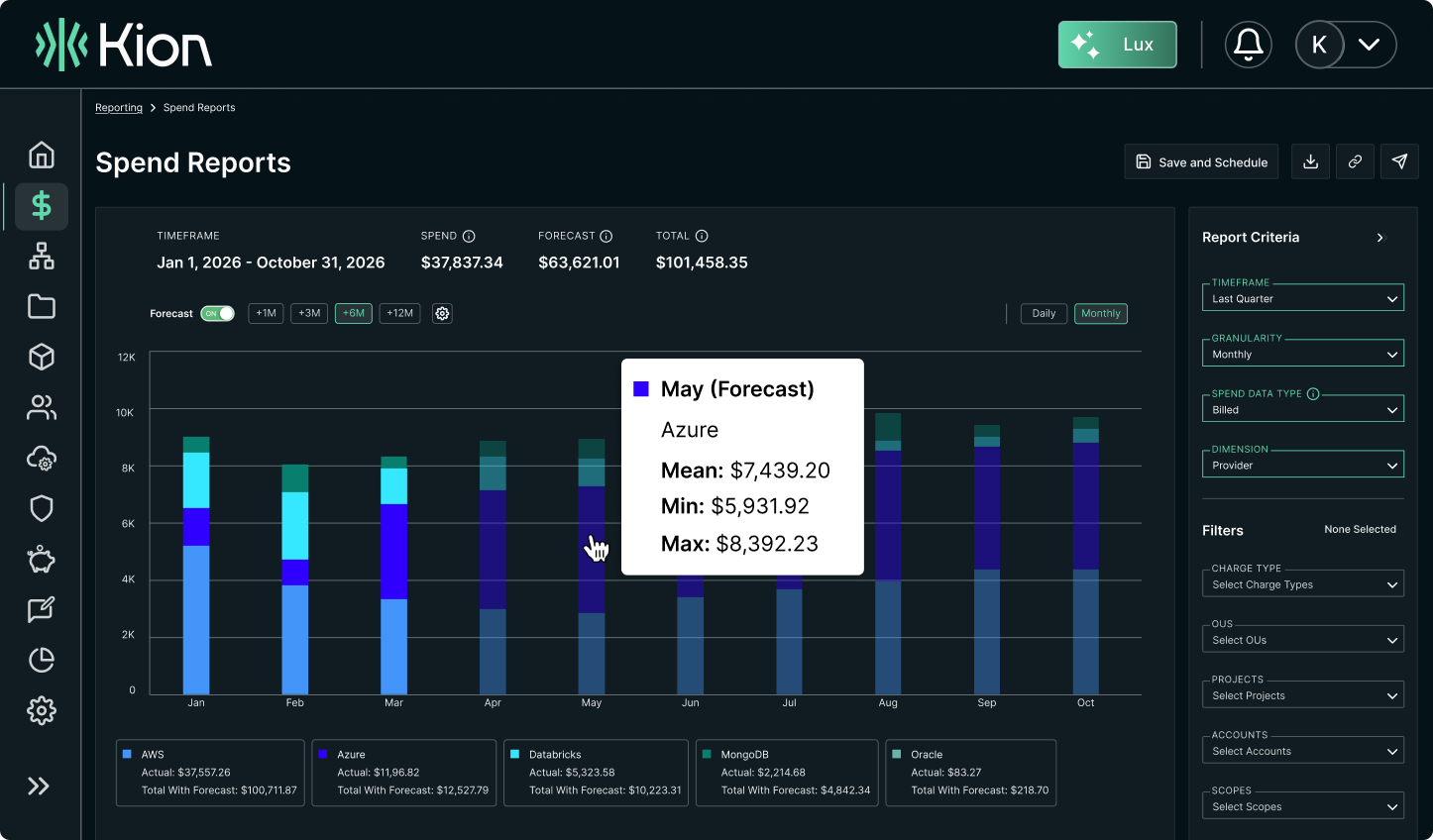
Kion’s cloud cost forecasting is built for how real organizations grow:
- Model future spend using historical data, growth multipliers, and trend-based forecasting
- Adjust time horizons to support quarterly planning, annual budgets, or rolling 30/60/90-day forecasts
- Explore scenarios to understand the cost impact of seasonal demand, new product launches, or infrastructure expansion
- Surface driver-based forecasting insights that show which services, teams, or workloads are driving projected cost increases
- Achieve more accurate forecasts by layering organizational context onto the model — reflecting how your business actually grows, not just how your cloud usage trended last quarter
For regulated enterprises managing hundreds of accounts, Kion’s forecasting scales without manual upkeep, making continuous cloud cost forecasting a standard practice rather than a quarterly scramble.
AI-Driven Forecasting That Gets Smarter Over Time
Kion brings AI-assisted forecasting to FinOps teams that need more than static trend lines. Machine learning models analyze historical usage patterns, identify consumption drivers, and generate forward-looking spend projections that improve in accuracy as your environment grows and changes.
The in-app Lux AI agent extends this further, allowing any team member to ask natural language questions about forecasted spend, explore cost drivers, and surface optimization opportunities without requiring deep platform expertise or manual analysis. Predictive analytics become accessible to everyone, not just the FinOps practitioners who built the model.
- Ask Lux questions like “What’s driving our projected Q3 cost increase?” and get instant, context-aware answers grounded in your live forecast data
- Apply machine learning models that adapt to your organization’s actual growth patterns over time
- Surface financial modeling insights that connect forecasted spend to business outcomes — not just cloud usage metrics
Share forecast data with finance and leadership through role-based dashboards that don’t require raw billing data access.
Budget and Alerting
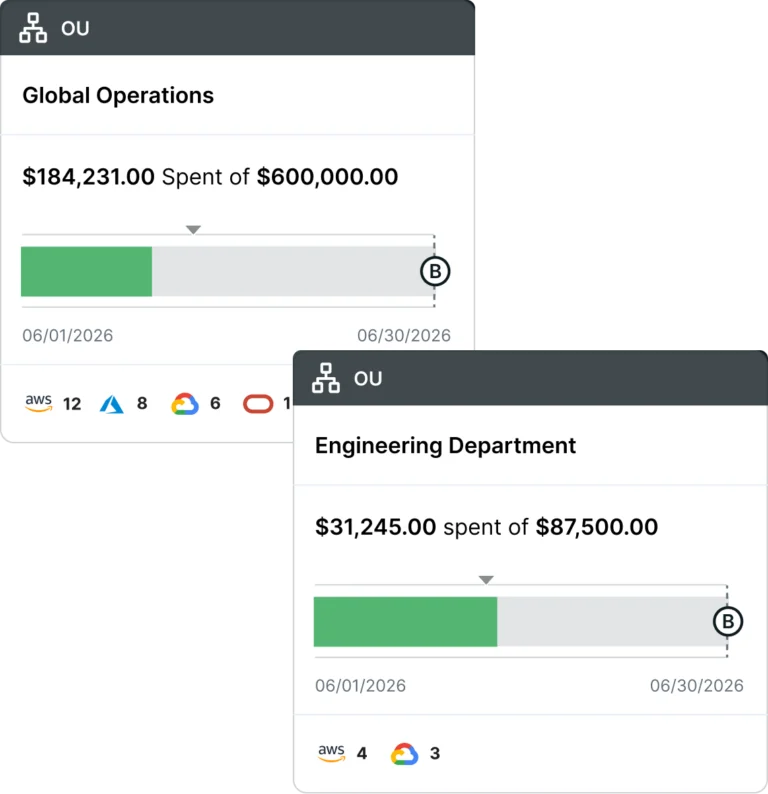
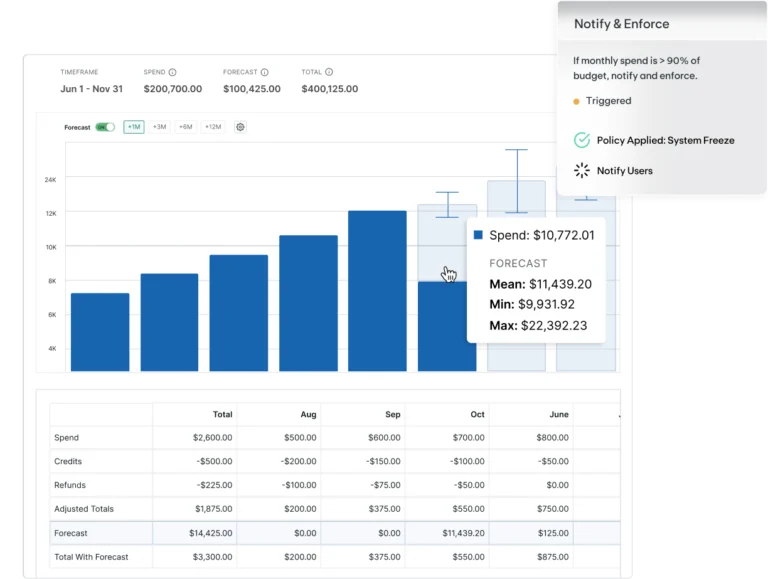
Forecasting is most powerful when it connects directly to budgets and enforcement. Kion’s Budgeting & Alerting capabilities let you take forecasted spend projections and turn them into active budget controls with thresholds that trigger automated enforcement when spending diverges from plan.
Frequently Asked Questions
What is cloud cost forecasting?
Cloud cost forecasting is the process of using historical cloud usage data, growth trends, and consumption patterns to predict future cloud spending. Accurate forecasting helps organizations set realistic budgets, identify likely overruns before they occur, and align cloud investments with business goals. Kion’s cloud cost forecasting uses trend-based and driver-based modeling across multi-cloud environments to give FinOps teams a unified, accurate view of projected spend without stitching together data from multiple billing consoles.
What's the best way to forecast cloud costs across AWS, Azure, and GCP?
The most effective approach is a unified multi-cloud forecasting platform that normalizes billing data across providers and applies consistent modeling to project future spend. Kion delivers unified cloud cost forecasting across AWS, Azure, GCP, OCI, and beyond in a single interface — with forecasts mapped to your organizational structure rather than just cloud accounts. This eliminates the reconciliation overhead of managing separate forecasts per provider and gives finance and engineering teams a single source of truth for projected spend.
How does AI improve cloud cost forecasting accuracy?
AI-driven cloud cost forecasting uses machine learning models to analyze historical usage patterns, identify consumption drivers, and generate more accurate projections than manual trend analysis. Kion applies AI-assisted forecasting that adapts to your organization’s actual growth patterns over time, improving accuracy as the model learns your environment. The Lux AI agent also allows team members to ask natural language questions about forecasted spend and surface cost drivers instantly, making forecasting accessible to every stakeholder, not just FinOps practitioners.
How does Kion's cloud cost forecasting differ from AWS Cost Explorer or Azure Cost Management?
Native tools like AWS Cost Explorer and Azure Cost Management provide forecasting within a single cloud provider. Kion delivers unified multi-cloud cost forecasting across AWS, Azure, GCP, OCI, and beyond in a single interface with forecasts mapped to your organizational structure rather than just cloud accounts. Kion also connects forecasting directly to budget enforcement and anomaly detection, closing the loop between prediction and action in a way native tools cannot.