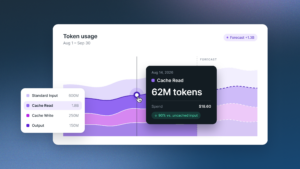
Recently, Amazon introduced enhanced cost attribution capabilities for Amazon Bedrock, making it easier for organizations to understand exactly which departments, teams, and individuals are generating AI spend. By leveraging IAM principals and tags, organizations can now accurately allocate those costs back to the individuals, departments, and initiatives driving that spend. This is a core piece of what’s increasingly being called FinOps for AI, extending the discipline, accountability, and visibility practices of traditional FinOps to a new category of spend that behaves very differently from static compute or storage.
As AI becomes a larger share of enterprise technology spend, accurately attributing those costs becomes increasingly important. Amazon’s enhanced attribution capabilities represent a significant step forward, giving organizations the visibility they need to allocate costs with confidence, improve accountability, and better measure the business value of their AI investments.
However, while AWS now provides the foundation for granular cost attribution, capturing accurate data still depends on engineers consistently using the correct IAM identity and tagging context when interacting with Bedrock. That’s easier said than done. Manual role switching, credential management, and project-level tagging add friction to engineering workflows, and even small mistakes can weaken the accuracy of cost allocation data.
The UX Problem with Engineering AI Workflows
Consider an engineer working on two separate projects using AI:
- Project A: Customer Support Agent
- Project B: Internal Benchmarking
Throughout the day, the engineer uses Claude, and other AI models, through Amazon Bedrock to support both projects.
To properly attribute costs, the organization needs answers to questions such as:
- Who generated the spend?
- Which team, project, or application should it be attributed to?
- Which business initiative benefited from that investment?
AWS enables this attribution through IAM principals and tags. However, if engineers must manually select roles, manage credentials, and determine which tags to apply for each activity, attribution quality quickly degrades.
The result is a familiar FinOps challenge: the organization has the data model needed for accurate cost allocation, but the operational burden falls on engineers.
Using Cloud Access Roles to Automate Attribution
Attribute Costs to Individual Users
Kion Cloud Access Roles (CARs) simplify AWS access while automatically providing the identity context needed for Amazon Bedrock cost attribution. Organizations can create Cloud Access Roles aligned to projects, teams, environments, applications, or any other structure they use to measure AI investment and business value. Then, when a user federates into AWS using a Cloud Access Role, either through web access or short-term access keys, Kion calls AWS STS AssumeRole. This creates a time-limited session against the specified IAM principal, allowing Amazon Bedrock to attribute supported Runtime API usage to the individual user operating within that session.
Attribute Costs to Teams, Projects, and More with Session Tags
Knowing who generated AI spend is only part of the picture. Organizations also need to understand what that spend supports.
Cloud Access Roles can automatically attach AWS session tags whenever a user assumes a role. These tags can represent virtually any business dimension, including:
- Project
- Team
- Department
- Application
- Environment
- Cost center
- Initiative
- And more…
Because these session tags are attached automatically during the AssumeRole process, engineers don’t need to manually apply tags or switch credentials. Every supported Amazon Bedrock Runtime API request (such as InvokeModel) inherits both the IAM principal and the session tag context.
The result is two complementary attribution dimensions:
- IAM principal identifies who generated the AI spend.
- Session tags identify what the spend should be allocated to.
Together, they enable organizations to accurately attribute Amazon Bedrock costs across both individual users and the business entities they support.
Example Cloud Access Role Setup
Cloud Access Role: Customer Support Agent Project
IAM Principal: User A
Default Session Tags:
department=engineering
project=support-agent
Cloud Access Role: Internal Benchmarking Project
IAM Principal: User A
Default Session Tags:
department=engineering
project=internal-benchmarking
Instead of relying on engineers to remember tagging requirements, attribution becomes part of the access workflow itself.
Beyond CAR-Level Session Tags
In addition to CAR-level session tags, Kion Cloud Access Roles also support tags delivered through SAML assertions. This provides organizations with additional flexibility for incorporating identity, access, and business context into their cloud cost allocation strategy.
User-level (SAML) session tags come from the identity provider at login. Any assertion attribute named https://aws.amazon.com/SAML/Attributes/PrincipalTag:[key] is captured automatically and merged into every session that user starts, enabling per-user attribution even when a whole team shares one CAR.
When a key exists at both levels, the user-level value wins, so a shared role can carry sensible defaults while identity-specific values override them where it matters. Tags are also marked transitive, so they survive role chaining.
Attributing Bedrock Spend Using the Kion CLI Tool
The Kion CLI is the most convenient way for engineers to use a CAR for programmatic Bedrock access. The CLI tool authenticates against your Kion instance and obtains short-term keys through the same Kion API as the web UI, so every credential it hands out carries the same role ARN and session tags ensuring that Bedrock attribution works identically. This makes it effortless for engineers to attribute Bedrock costs correctly without changing how they build or deploy AI applications.
Get started attributing Bedrock spend with our step-by-step user guide: AWS Bedrock Cost Attribution with Kion Cloud Access Roles and Session Tags →
Turning AI Cost Attribution into Actionable FinOps Data
Once Bedrock costs are accurately attributed, organizations can use Kion to monitor, forecast, budget, and report on AI spending. The same FinOps practices already applied to cloud infrastructure can now be extended to AI.
With Kion’s Scopes feature, organizations can group AI spend in whatever way best reflects the business. Scopes can be defined using granular criteria such as provider tags, services, charge types, line items, resource IDs, IAM principals, and more.
For example, an organization might define Scopes such as:
- Customer Support Agent: Criteria: tag is project=support-agent
- Internal Operations AI: Criteria: tag is project=internal-benchmarking
Once those Scopes are in place, every Bedrock invocation attributed through IAM principals and session tags automatically rolls into the appropriate business view. This enables accurate reporting, budgeting, forecasting, and chargeback without requiring engineers to manually classify their AI usage.
With this level of visibility, FinOps teams can answer questions such as:
- How much are we spending on each AI initiative?
- Which projects are generating the highest AI costs?
- How is AI spending trending over time for each initiative?
- What is our projected AI spend over the next 3, 6, and 12 months?
- Are projects delivering business value relative to their AI investment?
This creates the foundation for Tokenomics, the emerging practice of understanding AI costs not just in dollars, but at the token level. Rather than simply knowing “we spent $X on Bedrock this month,” organizations can understand which models, teams, projects, and workflows are consuming tokens, how those costs are changing over time, and whether the resulting business value justifies the investment.
Attributing AI Spend to Measure AI ROI
Measuring AI ROI begins with attribution. Before organizations can evaluate business value or optimize AI spending they need confidence that AI spend is accurately associated with the people, teams, projects, and initiatives responsible for it.
AWS provides the attribution framework. Kion Cloud Access Roles make it automatic and effortless. Together, organizations get the reliable foundation needed to extend FinOps practices to AI and make better decisions about where to make AI investments.
Beyond Visibility: Governing AI Spend
Visibility and attribution provide the foundation for FinOps for AI, but the next step is using that data to actively manage spend.
By applying budgets and guardrails, organizations can notify stakeholders as token usage or costs approach defined thresholds, and automatically restrict additional activity when those limits are reached. This helps teams prevent unexpected overruns while keeping AI investment aligned with business priorities.
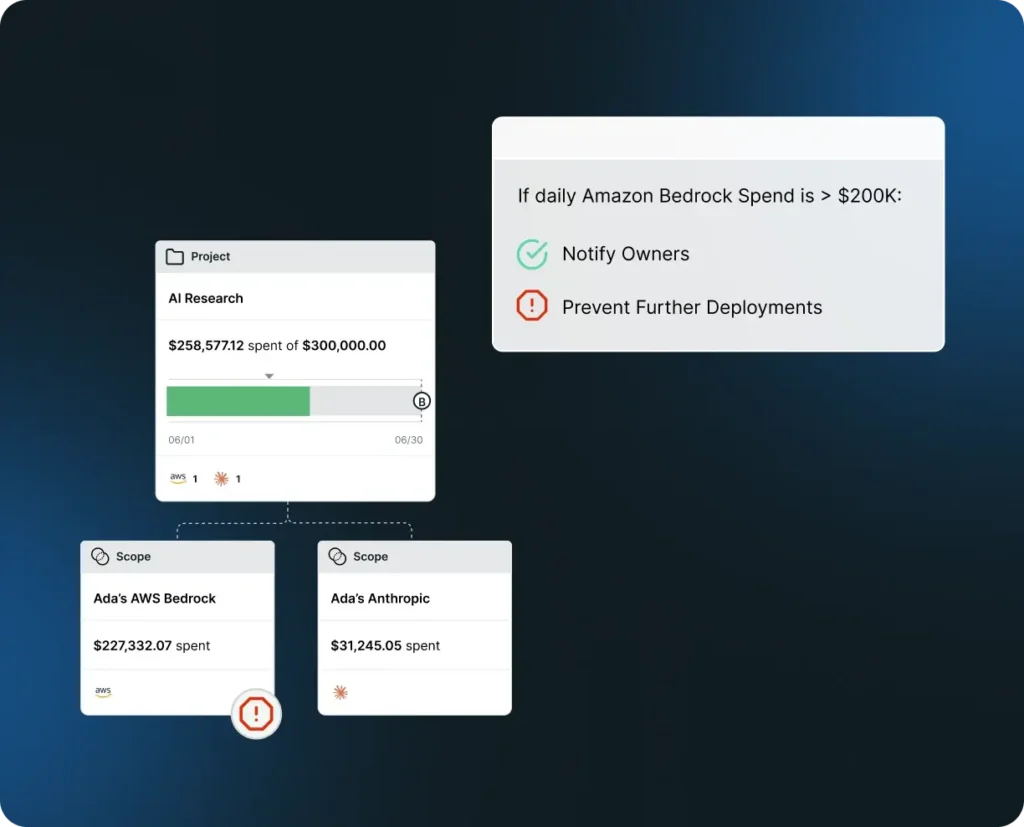
While this article focuses specifically on attributing Amazon Bedrock spend, Kion’s FinOps for AI capabilities extend across cloud providers, native AI providers, and beyond. [Learn more about Kion’s approach to FinOps for AI.]
Important Considerations
Bedrock Attribution Coverage
Bedrock has two separate serving paths:
bedrock-runtime: the original, native Bedrock endpoint. This is what Claude, Amazon Nova, Cohere, Mistral, and Titan models run on. It uses Bedrock’s native InvokeModel and Converse APIs, with per-model/per-account throughput quotas (classic RPM/TPM limits).
bedrock-mantle: a newer, separate distributed inference engine AWS built specifically to host third-party and open-weight models with an OpenAI-compatible interface (Responses API, Chat Completions API). Per AWS: bedrock-mantle is architected with advanced scheduling and work-queueing mechanisms that deliver fair-share distribution while supporting higher initial throughput limits, and this design allows it to host a broad set of models and deliver the full breadth of capabilities across the model catalog.
Currently, attributing bedrock usage only extends to the bedrock-runtime API not the mantle API that GPT-5.4 and GPT-5.5 use. Support for bedrock-mantle APIs is coming soon.
Session Tag Requirements
Users attributing Bedrock spend with Kion Cloud Access Roles must use short-term access keys or console access to apply session tags. Long-term access keys (LTAKs) authenticate as an IAM user under the hood, which cannot carry session tags, though principal attribution still applies.
Policy Enforcement
In some environments, it may be desirable to limit the use of Bedrock-related calls to only those that supply sufficient session tags. Using Kion, you can easily craft an IAM policy to be attached to all or any subset of your Cloud Access Role users to enforce that calls to Bedrock must be made with certain session tags in place. This ensures that you can eliminate unattributed spend through Kion.
Frequently Asked Questions
How do I attribute Amazon Bedrock costs to specific teams or projects?
AWS enables Bedrock cost attribution through two mechanisms: IAM principals (which identify who made the API call) and session tags (which identify what that call should be attributed to — team, project, department, or initiative). The challenge is that engineers must manually manage role switching and tag application, which degrades attribution accuracy over time. Kion Cloud Access Roles automate this by embedding the correct IAM principal and session tags into every credential issued, so attribution is accurate by default without adding friction to engineering workflows.
How do IAM roles and session tags enable AI cost attribution?
When a user calls the Amazon Bedrock Runtime API, AWS captures the IAM principal identity associated with the request. Session tags (key-value pairs attached during the AssumeRole process) extend that attribution to business dimensions like project, team, or cost center. Together, they provide two complementary attribution axes: who generated the spend (IAM principal) and what it should be allocated to (session tags). Because session tags must be applied at the time the credential is created, automating that step, as Kion CARs do, is what makes attribution reliable at scale.
What is the best way to implement FinOps practices for AWS Bedrock?
Start with attribution: ensure every Bedrock API call is associated with an IAM principal and carries the session tags that reflect your organizational structure. Without accurate attribution, budgets and forecasts are built on incomplete data. Once attribution is in place, use Scopes to group spend by business entity, apply budgets and threshold alerts at each Scope level, and enable automatic enforcement to prevent overruns. This sequence (attribute, group, budget, enforce) mirrors how FinOps practices work for traditional cloud infrastructure, extended to token-level AI spend.
What is the difference between bedrock-runtime and bedrock-mantle?
Amazon Bedrock uses two separate serving paths. The bedrock-runtime endpoint is the original native Bedrock infrastructure, supporting models such as Claude, Amazon Nova, Cohere, Mistral, and Titan via the InvokeModel and Converse APIs. The bedrock-mantle endpoint is a newer distributed inference engine built specifically to host third-party and open-weight models with an OpenAI-compatible interface (Responses API, Chat Completions API). IAM principal attribution for cost tracking currently applies to bedrock-runtime only; bedrock-mantle attribution support is listed by AWS as coming soon.
Can I govern AI spend without changing how engineers work?
Yes. Kion can attribute Amazon Bedrock spend back to the IAM principals consuming AI services, regardless of how those principals obtain AWS credentials. If you’re using Kion Cloud Access Roles, that attribution context is embedded automatically during credential issuance through IAM principal identity and session tags. Engineers continue authenticating and building as they do today (without extra tagging, manual role selection, or workflow changes) while attribution, budgeting, and enforcement happen transparently at the access layer.
Kion can also help with associating Bedrock spend to ROI even when Cloud Access Roles are not in use. By leveraging IAM principal and tag data available in the new CUR 2.0 columns, Kion can map spend to the people, teams, and initiatives responsible for it. This provides the granular visibility organizations need to measure AI costs, manage budgets, and track the return on their AI investments.