At FinOps X this year, the opening keynote featured a story that many practitioners immediately recognized. A company was 3x over its entire 2026 token budget by April. The conversation in that organization shifted overnight from “how do we move fast” to “how do we add guardrails?”
That story is not an outlier. The State of FinOps survey found that 98% of FinOps teams are now managing AI spend. But managing it and understanding it are two different things. Most organizations are reacting to costs they can see rather than governing usage they cannot predict.
This is the core challenge of AI tokenomics: AI spend does not behave like cloud spend, and the traditional FinOps playbook does not cover it cleanly.
Why AI Token Spend Is Different from Cloud Spend
Cloud FinOps gave practitioners a solid foundation: visibility into compute and storage, allocation by team or account, and governance through budgets and policies. Apply that same playbook to AI and it falls short in three specific ways.
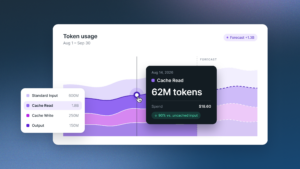
- Token-based billing is non-deterministic. With a virtual machine, you know exactly what you pay per hour. With AI, tokens are a meter, not a measure of value. A single prompt can consume 20,000 tokens or 20 million, and you cannot know in advance. That unpredictability introduces a level of cost risk that fixed-rate compute never did.
- Scale and speed are an order of magnitude different. A single user action can kick off multiple requests across multiple models or agents, compounding costs within minutes. Agentic workflows amplify this further, since each step in a chain generates additional token consumption downstream.
- The user base is now the entire organization. FinOps teams spent a decade building relationships and processes with engineering. AI changes the scope entirely. Developers, marketers, salespeople, finance teams, and executives are all generating AI costs, often with no visibility or accountability in place. The governance problem is no longer contained to technical teams.
Understanding these differences is what determines whether your AI cost governance strategy works. The organizations that try to apply traditional cloud FinOps to AI token spend will keep finding themselves behind.
See It: Visibility Is the Foundation
No governance or optimization is possible without visibility first. This holds for cloud and is even more true for AI spend, where costs can scale in minutes across dozens of teams and use cases.
Building AI visibility is not a single step. It is a progression through five stages:
- Inventory your AI usage. Start by understanding what API keys exist across your organization, which providers they connect to, who owns them, and what they are used for. This sounds basic, but it is a prerequisite for everything else. Without it, attribution is not possible.
- Attribute tokens to teams, projects, and use cases. The goal at this stage is to map every token back to a team or use case at minimum. Maturity looks like starting with consumption by provider, then working toward cost per invocation, and eventually reaching the point where you can attribute tokens to a specific business outcome. Full attribution may not be achievable immediately, but a solid foundation is the target before moving forward.
- Build dedicated AI reporting. Blended dashboards that combine cloud, SaaS, and AI spend have their place, but AI usage requires its own dedicated visibility. Token consumption, model usage, spend by user, and budget tracking across AI initiatives all need their own reporting surfaces because the unit economics and the conversations they enable are fundamentally different from traditional cloud cost management.
- Define unit metrics that connect to value. Once you have attribution and reporting in place, the question becomes measurement. What are the unit economics that matter for your AI usage? Cost per invocation is a starting point. Cost per outcome, whether that is a resolved support ticket, a generated code commit, or a closed deal, is where the real value conversations happen.
- Build anomaly detection for AI spend. Just as FinOps teams built alerting for unusual cloud usage patterns, the same discipline applies to AI. Automated alerts when spend spikes or crosses thresholds, routed to the right owners, are a requirement for managing AI at scale.
These five steps represent the foundation that every subsequent governance and optimization effort depends on. You cannot properly govern or optimize what you cannot see.
Control It: Guardrails That Enable Innovation
The instinct when costs spike is to lock things down. The goal of AI cost governance is not to slow innovation. It is to allow innovation to happen with accountability built in from the start.
The Tokenomics Foundation, which is actively defining roles and frameworks for this space, emphasizes that guardrails are a requirement because they are how organizations create real accountability at scale. The practical challenge is keeping those guardrails loose enough that they enable rather than block.
There are four stages to building effective AI cost governance:
- Govern access to API keys and models. Just as FinOps teams became stakeholders in cloud account provisioning, the same applies to AI access. When a new API key is provisioned, there should be a defined process: what is the purpose, who owns it, and what constraints apply. FinOps practitioners may not own this process, but they need to be a stakeholder in it.
- Define model approval and restriction policies. Not every model should be available for every use case. At the org level, certain models may be restricted for compliance reasons. As you mature, you can add use-case-level restrictions, for example, blocking high-cost frontier models for use cases where a smaller, cheaper model delivers the same outcome.
- Start with soft limits and early warnings. Before hard enforcement is in place, the most practical step is defining budgets across teams and use cases and alerting owners when they are approaching or crossing thresholds. The goal at this stage is awareness. People cannot manage spend they cannot see.
- Enforce selectively as you mature. Hard limits look different for every organization, but examples include throttling usage when a budget is crossed, rerouting requests to lower-cost models, or blocking requests outright for certain accounts or use cases. Not every use case requires hard enforcement, but every organization has use cases that do.
Provider-native tools may be enough to get started. Most AI providers offer workspace-level spend limits, model restrictions, and basic alerting. As usage grows and becomes more distributed across teams and providers, a platform or gateway becomes necessary to centralize visibility, normalize cost data across providers, and enforce governance in real time, including applying guardrails at the moment a key or account is provisioned rather than after the fact.
Scale It: Connecting AI Spend to Business Outcomes
Seeing and controlling AI spend creates the foundation. Scaling it is where FinOps practitioners shift from managing cost to driving value.
Define outcomes before you measure efficiency: Every AI use case should have a defined business outcome. A support agent exists to resolve tickets. A code generation agent exists to produce working features. Until you define what a use case is supposed to accomplish, there is no way to evaluate whether the investment is justified.
Set targets for cost per outcome: Once you have unit metrics in place, define what “good” looks like. That could be an industry benchmark, a comparison to the cost of performing the same task manually, or a target based on the revenue or savings a use case is expected to generate.
Shift FinOps left into AI planning: Just as practitioners fought for a seat at the table during cloud architecture decisions, the same mindset applies to AI. FinOps teams should be stakeholders in the planning of major AI use cases before they are deployed, not after costs have already accumulated.
Optimize once the foundation is in place:. Right-sizing models, reducing context length, improving prompt cache efficiency, and negotiating commitment discounts with providers are all valid optimization levers. But they require a foundation of visibility and attribution before they can be applied effectively.
Lead on culture: The practitioners who will have the most impact on AI spend are the ones who position themselves as educators and translators at their organizations. That means helping business stakeholders understand cost per outcome, not just cost per token, and driving a culture of continuous improvement around how AI usage is evaluated and expanded.
What AI ROI Actually Looks Like in Practice
The “Scale It” framework for AI spend becomes more tangible with a concrete example.
Consider two AI agents running in parallel at the same organization. Agent A is focused on identifying infrastructure cost savings. Agent B is focused on generating new product features through code.
On the surface, Agent A appears cheaper per commit. But when you trace spend to outcome, Agent A has consumed more than $15,000 and has generated approximately $11,000 in attributed savings. That is $1.38 spent for every $1 saved, which is negative ROI by any measure. The agent may still have a path forward with model adjustments or workflow changes, but it is clearly a use case that needs attention rather than continued investment.
Agent B tells a completely different story. With just over $5,000 in spend, it has been attributed to more than $300,000 in net new revenue from the features it helped generate. That is approximately two cents of AI spend per dollar earned, making it an obvious candidate to expand.
This is the type of analysis FinOps teams should be leading. The goal is not to report a cost number in isolation. It is to connect spend to the outcomes that matter to the business, and use that connection to make better decisions about where to scale AI investment and where to pull back.
Watch the on-demand session to see the full Agent A vs. Agent B demo walkthrough.
Where to Start Based on Where You Are
Not every organization is at the same point in this journey, and the right first step depends on where you are today.
If you are just getting started: Do not write a single policy until you can see your spend. Inventory your API keys, start attributing tokens to teams, and build the reporting foundation first. Guardrails on top of invisible spend does not work.
If you have some visibility in place: Shift focus to guardrails. Define budgets, build soft alerting, and establish model policies before moving to hard enforcement. The goal is accountability before restriction.
If you have visibility and guardrails in place: The question becomes value. Are your AI use cases delivering the outcomes they were designed to deliver? What are your unit metrics, and how are they trending? Which use cases deserve more investment, and which need to be rethought?
For a full overview of the capabilities that support each stage, download the FinOps for AI datasheet.
FAQ: FinOps for AI Tokenomics
What is the See It, Control It, Scale It framework for AI spend?
See It, Control It, Scale It is a three-stage framework for managing AI token spend as an organization. See It establishes visibility through inventory, attribution, dedicated reporting, unit metric definition, and anomaly detection. Control It builds governance through access management, model policies, budget thresholds, and selective enforcement. Scale It connects that foundation to business outcomes by defining cost-per-outcome metrics, setting improvement targets, and using data to decide which AI use cases to expand and which to pull back.
How did AI break the traditional FinOps playbook?
Cloud FinOps was built around predictable, resource-based billing: VMs, storage, and network priced by the hour or gigabyte. AI token billing is non-deterministic. A single prompt can consume 20,000 tokens or 20 million with no way to know in advance. Costs can compound across agentic workflows in minutes rather than days. And the user base has expanded beyond engineering to include every business function, which means the attribution, collaboration, and governance models that worked for cloud do not translate directly to AI.
What is the first step in managing AI token costs?
Inventory. Before any governance or optimization is possible, organizations need to understand what API keys exist, which providers they connect to, who owns them, and what they are used for. Attribution and reporting build from that foundation. Writing policies before you have visibility in place is one of the most common mistakes FinOps teams make when approaching AI spend for the first time.
How do you compare ROI across different AI agents or use cases?
Start by defining a clear business outcome for each use case, then track cost against that outcome at the unit level. A support agent should be measured by cost per resolved ticket. A code generation agent by cost per shipped feature or attributed revenue. When you compare agents side by side using those unit metrics, the investment decisions become clear. An agent generating $1.38 in cost for every $1 saved needs attention. An agent generating two cents in cost for every dollar of revenue it helps produce is an obvious candidate to expand.
Why is AI cost forecasting so difficult?
Unlike cloud workloads, AI token consumption depends heavily on how users interact with a model or application. The same architecture and use case can produce dramatically different costs depending on prompt behavior, usage frequency, context length, and agentic workflow complexity. Because forecasting remains unreliable for most organizations at this stage, guardrails are currently the most practical mechanism for managing cost variability. They create a ceiling while forecasting models continue to mature.
What role do AI gateways play in FinOps for AI?
AI gateways centralize visibility and governance across multiple providers and user types. For organizations with significant AI usage coming from different teams and tools, a gateway provides real-time spend data at the moment a model is invoked rather than waiting for billing file updates, cross-provider normalization, and the ability to enforce policies consistently across the organization. See how Kion approaches this with its FinOps for AI platform.
What is the Tokenomics Foundation?
The Tokenomics Foundation is an industry body that has formed to bring structure and shared frameworks to AI token cost management, similar to how the FinOps Foundation brought order to cloud cost practices. It is actively defining roles, personas, and governance standards for managing AI spend. The foundation’s emphasis on guardrails is notable: it frames them not as restrictions but as a requirement for creating real organizational accountability around AI usage.
Want to see how these concepts work in practice? Watch the on-demand session or explore our FinOps for AI capabilities to learn more about how Kion supports visibility, governance, and cost control across your AI spend.