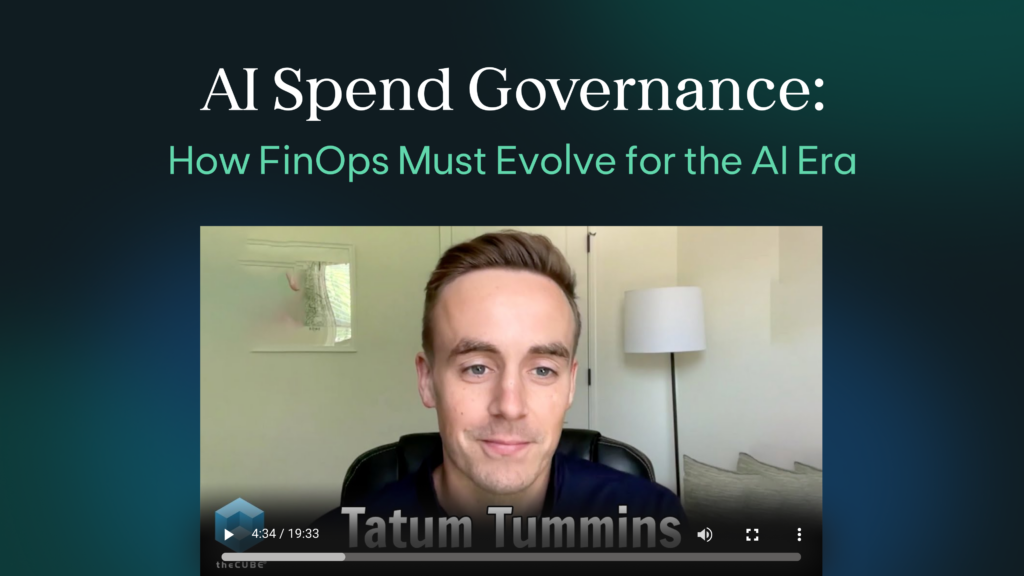


Featuring Tatum Tummins on theCUBE Research
As cloud and AI token spending accelerates, organizations need new ways to bring visibility, accountability, and governance to technology investments. The same FinOps practices that helped enterprises manage cloud cost complexity are now becoming essential for AI.
In this theCUBE Research interview, Kion Senior Product Manager Tatum Tummins joins Paul Nashawaty to discuss why AI spend governance is quickly becoming a top priority for enterprises, especially in regulated industries and federal environments. As AI usage expands beyond engineering into sales, marketing, product, and business teams, organizations need to understand who is driving costs, what value is being created, and how to prevent unexpected spend.
Tatum explains how FinOps teams can start by bringing AI token spend into the same dashboards, budgets, and governance workflows they already use for cloud. He also shares practical examples, including sandbox environments with automated budget controls, AI token-based visibility, and AI-powered workflows that make FinOps easier for non-technical users.
Watch the full interview to learn how organizations can build the visibility and governance foundation needed to scale AI responsibly.
Key Takeaways
Visibility Is the Starting Point
Organizations cannot govern or optimize AI token spend until they can see which teams, projects, agents, prompts, or users are driving costs.
AI Spend Is a Company-Wide Challenge
Unlike early cloud spend, AI consumption is spreading across business functions, including sales, marketing, finance, product, and engineering.
Governance Should Support Safe Experimentation
Sandbox environments, token budgets, alerts, and automated controls can help teams innovate without creating runaway costs.
FinOps and AI Teams Will Converge
As AI investments grow, FinOps teams are likely to become direct partners to AI teams and business leaders.
AI Can Make FinOps More Accessible
In-app agents and natural language workflows can help non-technical users create policies, understand chargeback, and identify anomalies faster.
Full Transcript:
[Paul Nashawaty] >> Hello and welcome. Today we’re here to discuss cloud financial operations, or better known as FinOps and the best practices. As cloud and AI spend surgeons, organizations are embracing FinOps to bring discipline and accountability to technology investments, aligning engineering, finance and business teams around smartest spending decisions. So we’re looking at events like FinOps X and how it highlights the practices as evolving beyond cloud into SaaS and AI while platforms like Kion are operationalizing FinOps with the visibility, automation and governance needed to manage cost complexity at scale. I’m Paul Nashawaty. I’m the practice lead and principal analyst at the Cube Research for the App Dev Practice and I’m joined by Tatum. Tatum, how are you doing today?
[Tatum Tummins] >> Hey Paul, thanks for having me. It’s good to be here.
[Paul Nashawaty] >> Yeah, great to have you on. Why don’t you introduce yourself and introduce Kion?
[Tatum Tummins] >> Yeah. So you covered the high level. My name’s Tatum Tummins, senior product manager at Kion. Something I always like to share with folks about me is prior to coming to Kion on the vendor side, I was a practitioner for almost eight years at a large healthcare company. So I like to say I grew up with FinOps. I saw it evolve from the early days before the foundation and then after the foundation when folks started to really understand what their job even was. I think my old title was R & D effectiveness before we actually knew what FinOps was going to become. But I always like to share that because I kind of grew up as a practitioner, made the transition over here to the vendor side and trying to give people the tooling that they need to be successful.
[Paul Nashawaty] >> Well, you bring in a wealth of knowledge to the conversation, a wealth of knowledge to the market here. Tatum, we see that AI spending in the cloud is accelerating at a pace that few organizations are really prepared to manage. With forecasting pointed to $ 2. 5 trillion in 2026 and when 44 % year- over- year growth, yet while investment surges, governance is really lacking. It’s leaving federal agencies and regulated environments struggling to answer basic questions about who’s driving the costs. And when we look at that, we also have to understand what value is being realized and why these surges and spikes are happening overnight. We see that happening. The challenge is no longer confined to engineering teams as we were previously just talking about, but obviously we see AI consumption is now embedded across sales, marketing, product and beyond.
And the widespread use of models and token- based services is really driving towards unpredictable spending. So without clear visibility and accountability, organizations are really turning to AI innovation as a financial and operational chaos. So Tatum, what’s your reaction to that? That’s a lot. That’s a mouthful for one, but what’s your reaction to all of that?
[Tatum Tummins] >> Yeah. You kind of nailed the setup of the problem. I think there are two things to remember that are a little bit distinct, but they’re important. And the first is that a lot of this is not new in terms of the general problems that we’re trying to solve. The same issues around folks trying to get visibility, understand the value they’re getting, trying to put some procedures and processes in place to have some real governance. This all existed two decades ago as people were starting to migrate to the cloud. So that piece, we’ve learned a lot of lessons that I hope folks are able to apply to this kind of new journey we’re going on in AI. But the part that is distinct and is different you touched on is what’s different about cloud versus just AI spend is that it is not just a trying to get your engineers to take action or be cost aware. It’s more of a holistic company effort. Even in our own internal company, we’ve got sales folks and marketing folks that are building agents to try to go off and do tasks and automate and that drives cost just like your engineers trying to develop new products. And so when you think about AI spend, AI governance, it’s a more of a holistic company problem that folks are starting to try to understand and see where they need to go, but we’re really lacking in that governance piece and also realizing what value are we actually getting from what we’re spending.
[Paul Nashawaty] >> Yeah, absolutely. And it also brings the question around how FinOps for AI or AI for FinOps. It’s really around that kind of model. So when we look at that, I think that there’s something I brought up right in the beginning here, which is AI spending is exploding and governance is struggling to keep up. We see that as a challenge. So Tatum, when we look at how analysts like myself and others in the industry are forecasting AI spending will reach $ 2. 5 trillion in 2026, 44 % year- over- year growth. What’s your reaction to that?
[Tatum Tummins] >> Yeah. So what I find interesting is the most recent survey from the Phantoms Foundation, 98 % of the respondents said that they’re now managing AI spend. But what I’m at least seeing from my perspective with prospects and customers is that managing is a little bit of a loose term. A lot of folks don’t even have proper visibility into, okay, what are our individual team spending? What are our AI project spending? Or even down to the, what are our specific agents or specific engineers spending? And folks are kind of looking at the bill and they’re seeing this kind of shock value, but they also know they need to be investing in AI to stay relevant in their market. And what I think is being missed right now is to even get to governance, to be able to understand how to pick the perfect model or restrict certain types of usage, you have to be able to see it. And a lot of folks have tried to almost skip that step. And so just like with the cloud, it starts with visibility.
How do you actually allocate spend so that you understand what it is that’s driving your cost? And then how do you actually put some sort of policy around how we want to manage that spend? Do we want to actually have restrictions in our sandbox environments to only have certain types of GPU models or certain models are only allowed within our lower environments before they go to production? Things of that nature.
[Paul Nashawaty] >> Yeah. I mean, Tatum, I think that it makes a lot of sense. I mean, cost is absolutely a factor. Governance, compliance, regulations is a factor. We see federal agencies and regulated enterprises. They’re facing growth pressures to justify AI investments. We also see that 25 % of IT budgets are allocated for AI projects, but yet they can’t answer the basic questions. Which teams are driving costs? What value? Why did the bills spike? These are the questions that many organizations are thinking about. So Tatum, I’d like to get your perspective on how to build visibility that needs justifying AI investments and governance controls that require for safe, accountable use without cost surprises. Because this is a factor, I mean, when we look at 2025, budgets were spent on AI with really not sure what that meant. Now it’s like, well, let’s figure out what this money’s being spent for.
[Tatum Tummins] >> Yeah. And it goes back to what I was just saying of we haven’t actually figured out how to best get folks to bring in this AI spend in the same dashboards that they’re already viewing every day for cloud. That is step one. That’s something Kion’s committed to. Lots of tools in the market are now are committed to helping folks bring in this spend, start to actually understand it, try to get some unit economics around it. I mean, unit economics has been a thing in the cloud that’s really taken off in the last couple years in the conversation. It’s even more important with AI spend actually understanding the value that you’re getting from these dollars, but it starts with having something, whether it’s homegrown or a third party tool that allows you to aggregate this spend, allocate it across your teams, understand down to a granular level, what are we actually doing that’s driving this spend so you can ultimately make some better decisions.
[Paul Nashawaty] >> But can FinOps teams really enforce policies? Can they really reduce the risk and eliminate unnecessary AI costs? I mean, this is really like you’re talking about the lines of business, the engineering teams, the folks that are using it. Those are the ones that have to do the enforcement. What are your thoughts on FinOps teams enforcing this execution?
[Tatum Tummins] >> Yeah, they should be able to. I will tell you right now a gap that we are seeing is right now AI and a lot of big enterprises is a separate team and that’s not going to last forever. Just like eventually at one point finance and FinOps were two separate teams that didn’t work together. Now they’re closely knit. We’re going to see that these dedicated AI teams become a part or direct partners with the FinOps team. And once that happens, your FinOps teams are going to have a little bit more oversight, a little bit more control. And I think what is being perhaps missed is folks don’t see AI spend as something that resembles cloud spend just because the economics of it are different, tokens versus hourly usage. But what you’re really talking about is are people using the right model for the work that you’re trying to do? Same conversation of, are we using the right EC2 for the work that we’re trying to do?
And then from there, how do you actually put in some restrictions? It might be as simple as a budget alert or a token alert. One of the things that we try to provide in our in- app experience when you actually use Kion’s in- app AI is we actually let you do a token restriction count for users. You can put in how many tokens you want them to be able to use in a given month. Little parameters like that go a long way in helping people kind of think about the spend that they’re creating when they run off and ask a prompt or do a task.
[Paul Nashawaty] >> Yeah. I think that’s an important point not to gloss over here. You mentioned it already, I kind of want to bring up the fact that AI costs are not just driven by engineering. That is absolutely true. We see that lines of businesses are creating applications. We see that they’re creating without having really an understanding of what the impacts are to their organization. So again, there has to be belts and suspenders in place in order for these things to work but I’ll also defer back to the governance, compliance, regulations, and controls having those guardrails and bumpers in place as well. But being driven by all elements of the organization, we see sales, marketing product teams. Everyone is driving anthropic or open AI token usage and spend. This is a factor that it’s kind of like early cloud days when people got their first cloud bills, they’re like, ” Wow, this is really expensive. ” Token spend is kind of out of control. What are your thoughts on that?
[Tatum Tummins] >> Yeah. And I think part of it is we’re going to go through a journey here and I think we’re still maybe a few months away, but one of the things that I think FinOps teams should be doing to help the entire organization understand how AI spends actually generated is this is something we try to do internally as well is give folks an example of what a cost- efficient prompt looks like. Right now, simple language is something we’re all exploring as human beings are changing to keep up with this technology, but there’s an art and a science to effective prompts that are cost- effective that still get the same job done. Things of that nature, giving folks examples as a team on what that looks like and then providing them the visibility of, ” Hey, here’s your token budget or your AI budget for the month. ” As you’re completing tasks, you’re having agents go off and do work on your behalf, being able to actually see how your tokens are trending towards your monthly allotment or your monthly billing, that alone builds that cost awareness. And then once they hit that limit, if this isn’t a production application, having a tool like Kion actually go out and restrict services or actually go out and actually do something on the behalf of the engineer when those thresholds are met, that’s really where governance becomes powerful and helps you prevent those cost overruns.
[Paul Nashawaty] >> So do you have any customer use cases or case studies that you can share that demonstrates this?
[Tatum Tummins] >> Yeah. So a great example, and this is the easiest one I think for folks to wrap their head around. Last year when AI was on a new concept, but it was definitely new in terms of the scale. We had a customer who was using AWS Bedrock trying out and experimenting, innovating in a sandbox environment. And what they actually did is they put a daily budget on how much they wanted their engineers to be able to spend on Bedrock in a given day. And because this was the sandbox environment, when Kion actually detected that threshold getting hit, we went out and actually stopped all resources for the given day and because we have the ability to also access identity and access information, we can actually just restrict access to the account until the next day. And so that was a way to let people safely explore and innovate up to a certain amount. And then the next day, they can complete the process of their innovation, but it’s putting that ceiling on how much you’re willing to invest into innovation while still staying within certain confines.
[Paul Nashawaty] >> Yeah. I love that example because it’s kind of the rubber hitting the road. It shows how what we’re talking about is applied towards customer use case and how they’re using it today. Tatum, FinOps teams are also integrating Agentic AI into the FinOps practices. So like you’re saying, and like you were leading up to this, this is not just a kind of a siloed monolithic kind of approach within organizations. This is a full context sport, so to speak. Everyone’s involved in it, everyone’s engaged, but asking the questions around natural language, triggering governance actions, automated workflows and managing cloud AI and SaaS spend within security and compliance controls impacts organizations that they …
These are tools that they’re already relying on. How is this pivoting and do you have any cases or use cases around how this is working? Because this is an area that I think I’m seeing with regards to maturity within a lot of organizations and how they’re getting to that next level.
[Tatum Tummins] >> Yeah. So as we pivot into the AI for FinOps topic here, one of my favorite things about what I’m seeing in AI is two specific use cases is one, you kind of just touched on it, but folks are getting comfortable with simple language. Impersonal or professional, we’re using ChatGPT, we’re using Cloud Desktop and that translates to how you want to use tools. And there’s a usability and a guidance piece where you start to get more comfortable asking simple language prompts to learn how to navigate a tool or to get the information you need. And it often cuts down the barrier to actually learning FinOps or learning how to use a given tool. The other piece off of that that I’m seeing folks start to lean into and take advantage of is AI actually cuts down on some of that technical barrier needed to do governance and policy at scale. So yeah, AI can come out and give you a recommendation for how to save money, but a lot of folks see that recommendation and they don’t know what to do about it.
How do we proactively prevent that from happening again? Something we’re seeing folks use our in- app agent for is actually creating policy for them when they maybe don’t necessarily have the technical expertise on how to write that policy. AI, we’ve created a sub- agent essentially in our tool to help them create that policy that they then can implement. And so we’re seeing it reduce that technical barrier and also just make FinOps a little bit more usable for all personas. And I think when you do that, but you do it in the way that I described earlier where you put token limits on how much folks can consume, you start to then create a safe space for folks to explore, get what they need from a tool without going too far.
[Paul Nashawaty] >> All right. Let’s talk a little bit more about that because that’s important. I don’t want to gloss over that. Speak about usability and guidance that AI and FinOps provide for new FinOps practices or maybe ones that are less technical because it is kind of that bridge where we’re looking at sometimes, as you stated early on, FinOps can be procurement, it can be engineering, it can be lines of businesses. What about the organizations just getting started? How do they get going?
[Tatum Tummins] >> Yeah. So I’m going to give you a great example for this. We have a new customer in the security space and they have an accountant that every month has to go through their chargeback process, how they want to allocate spend. And our in- app agent has given this resource a prompt that they can come in and click on and immediately essentially get the answers that they normally had to spend hours dividing up a report, trying to figure out what they’re looking for. They now have a one- click prompt that they go and that’s what they need to get their job done. So it made them more efficient and it also solved that gap of them not really knowing how to use the FinOps tool because they were a little bit separate from the team. And so when you think about that person being new to FinOps and having new needs on what’s our AI spend this month, and they can just go click a prompt or ask a simple question, you’re really cutting down that gap both from a culture standpoint of a FinOps feeling like it’s too far away for someone on the accounting team to participate in.
But in your case, where you say even a new organization that this is all brand new, it’s a way to learn and explore what is FinOps. You can ask that question and say, ” Hey, I’m new to this. What are some things I should look at in my environment that seem like an anomaly or something that deserves more attention? ” And asking those prompts, and then what my favorite is, and we’ve made sure we’ve done that in our experiences, those follow- up questions that you might want to ask that you may not have even been thinking about to ask, it just makes a much better experience and helps you actually get value from the tool so much faster.
[Paul Nashawaty] >> Yeah, definitely insightful. Tatum, hey, we’re coming to an end. We talked a lot about FinOps, we’ve talked a lot about getting going and get started, the impacts organizations. I want to give you the final words. Where can organizations go to get started? Where do you recommend? What can Kion do to help?
[Tatum Tummins] >> So at a high level, I think the FinOps foundation is doing a great job of creating and keeping up pace with the language of use cases and ways to be thinking about this. But for folks that are out there that are looking for tooling to help with this, Kion will be at FinOps X I believe next week when this comes out. We’ll have a booth there if you want to come and talk to me. I’ll be around on our story and what our vision is for how we help folks in this space. But I really encourage anyone listening to this that maybe is on the fence about how much to invest in FinOps for AI and governance for AI spend. I promise you the work that you put in now through getting this kind of set up, the visibility piece and the governance piece as AI is still at least a little bit early in your journey, it’s going to pay dividends in the long run as this scales and you need to have these controls over this spin that will continue to expand. And so if you want to come hear more about how Kion does that, we’d love to talk further and see if we can help out your use cases.
[Paul Nashawaty] >> Tatum, super insightful, awesome. Always great to have a conversation with you. Looking forward to continuing our conversation at FinOps X in San Diego. It’s going to be great time. It’s always a great time, great event and thank you for being on the show today. This has really been helpful. Thank you. And Ben, thank you for being our guest and a big thanks to all of you who’ve tuned in. We really appreciate your interest in theCube, your leading source for enterprise tech news.