

AI is quickly becoming part of how organizations build and scale in the cloud.
But the speed of AI adoption is outpacing the controls most organizations have in place.
The challenge is not just visibility into AI token spend. It’s controlling how AI resources are used, especially in non-production environments where experimentation happens fast and oversight is often limited.
In our recent session, Stop the AI Bleed: FinOps Guardrails for AI Cloud Spend, Kion Senior Product Manager for CloudOps & Automation, John Hall, explored the growing problem of unmanaged AI cloud spend, especially in non-production environments, and shared practical strategies organizations can implement today to govern AI token costs more effectively.
The conversation centered around three core areas:
- FinOps controls for AI token spend
- Policy guardrails for safe experimentation
- Automated governance to eliminate unnecessary spend
Here’s what effective FinOps governance for AI actually looks like in practice.
AI Token Spend Is Growing Fast. Governance Is Struggling to Keep Up.
AI cloud spend is growing faster than many organizations are prepared to manage.
While production workloads often receive the majority of governance attention, non-production environments are where AI experimentation frequently happens with less oversight. Sandbox, development, and testing environments make it easy for teams to move quickly, but they also create opportunities for idle resources, overprovisioning, and uncontrolled costs.
Recognizing this less-discussed area of “AI bleed” is critical to appropriate FinOps governance. It is often happening quietly in experimentation environments where expensive resources continue running long after teams stop using them. Unlike traditional development environments, AI experimentation can often require:
- GPU-intensive infrastructure
- Large-scale data processing
- High-performance compute resources
- Long-running workloads
- Expensive model training environments
This challenge becomes even more important as AI adoption expands across engineering, operations, analytics, and business teams. Left unmanaged, these environments run overnight, over weekends, and long after the work is done.
Visibility Alone Is Not Enough
A major challenge for organizations today is the gap between visibility and control.
AI workloads introduce governance challenges that differ significantly from traditional cloud workloads.
AI experimentation is often:
- Faster-moving
- More decentralized
- More resource-intensive
- More difficult to predict
Many organizations already have dashboards, reports, or cloud cost monitoring in place. The problem is that identifying spend after it happens does not necessarily prevent waste.
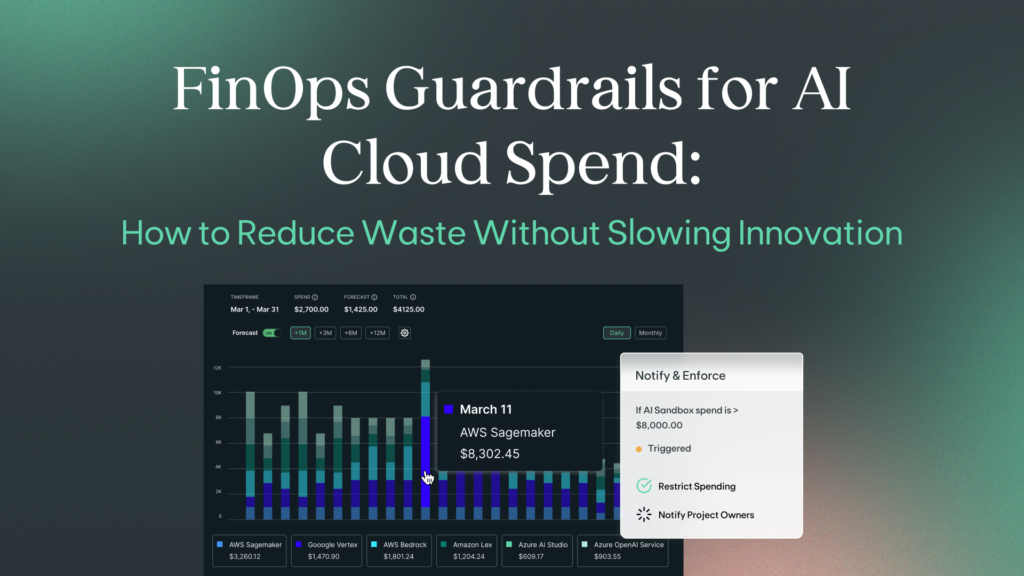
FinOps teams need governance models that move beyond passive visibility into active enforcement.
That includes:
- Defining policies for AI-related resource usage
- Establishing operational boundaries for experimentation
- Automating enforcement actions when environments exceed expectations
- Applying governance consistently across cloud environments
The goal is not to slow teams down but to create clear operational guardrails that allow experimentation to happen responsibly. The organizations seeing the most success with AI are often the ones balancing innovation with automated governance from the start.
Automated Governance Should Enable Innovation, Not Block It
Governance and innovation should not be treated as opposing goals.
Engineering teams need flexibility to experiment with AI technologies. FinOps teams need confidence that experimentation will not create runaway costs.
The answer is not tighter restrictions across the board. Modern AI governance models need to be:
- Proactive instead of reactive
- Inclusive of automation where it makes sense
- Policy-driven instead of ad hoc
- Flexible enough to support innovation
This shift is becoming increasingly important as AI adoption expands across more teams, workflows, and business functions.
Instead, organizations need guardrails that support safe AI experimentation while automatically enforcing operational standards and accountability behind the scenes. Automation is quickly becoming a foundational requirement for modern FinOps practices as well. Traditional governance approaches that rely on manual reviews, ticketing workflows, and reactive cleanup efforts do not scale well for AI environments.
Some examples of guardrails and automated governance include:
- Allowing approved AI services while restricting unapproved ones
- Defining environment-level policies based on team or use case
- Creating automated controls for after-hours resource management
- Applying cost-aware automation policies that reduce waste without requiring constant manual oversight
- Automated Budget enforcement controls on sandbox accounts
As adoption expands beyond centralized AI innovation teams and into everyday cloud operations, this balance between autonomy and governance is becoming increasingly important.
Kion provides the means to establish these guardrails and automated governance in your cloud accounts as part of our FinOps+ capabilities. Specifically, Kion’s Cloud Rules help you apply policy-level configurations automatically, Automation Policies allows you to tag and control your resources off-hours and eliminate clear waste, and the Budgets feature allows you to take control of your financial posture.
The Future of FinOps for AI
The organizations that succeed will not simply be the ones adopting AI the fastest. They will be the ones building governance strategies that allow AI experimentation to scale responsibly.
Organizations do not have to choose between innovation and governance.
With the right FinOps controls, policy guardrails, and automated enforcement strategies in place, teams can reduce waste, improve accountability, and scale AI cloud usage with greater confidence.
As AI adoption continues to accelerate, governance will become a critical part of how organizations control costs, manage risk, and operationalize AI successfully at scale.
Are you interested in seeing some of these things in practice and to learn how you can tackle these challenges in your environment in a practical way? Check out our webinar:
You can also explore our related blog: What the Last Decade of Cloud Taught Us About FinOps for AI
FAQ: FinOps Guardrails for AI
What are FinOps guardrails for AI?
FinOps guardrails for AI are policies, automation rules, and governance controls designed to help organizations manage AI token cloud spend responsibly. These guardrails help reduce waste, enforce operational standards, and prevent unnecessary costs without slowing down experimentation.
Why is AI token cloud spend difficult to govern?
AI workloads often require expensive compute resources, large-scale data processing, and long-running environments. In many organizations, AI experimentation happens in non-production environments where governance is less consistent, making it easier for costs to grow unchecked.
Why are non-production AI environments a major cost risk?
Sandbox, development, and testing environments frequently contain idle or overprovisioned AI resources that continue running after experimentation ends. Without automated governance, these environments can quietly accumulate significant cloud costs.
How can organizations reduce unnecessary AI cloud spend?
Organizations can reduce AI cloud waste by implementing automated governance controls such as idle resource shutdowns, time-based policies, budget enforcement controls, and environment expiration policies.
What is automated governance in FinOps?
Automated governance refers to the use of policies and automation to enforce cloud cost controls in real time. For AI workloads, this can include automatically shutting down unused infrastructure, enforcing operational boundaries, and applying cost controls without requiring manual intervention.
Does FinOps governance slow down AI innovation?
Effective FinOps governance should support innovation, not restrict it. Modern governance models are designed to create operational boundaries that allow teams to experiment safely while reducing unnecessary cloud spend and financial risk.