

AI is no longer a side conversation in FinOps. It’s becoming part of how teams operate.
But insight without execution doesn’t change outcomes. Real value is driven by a team’s ability to move from insight into action.
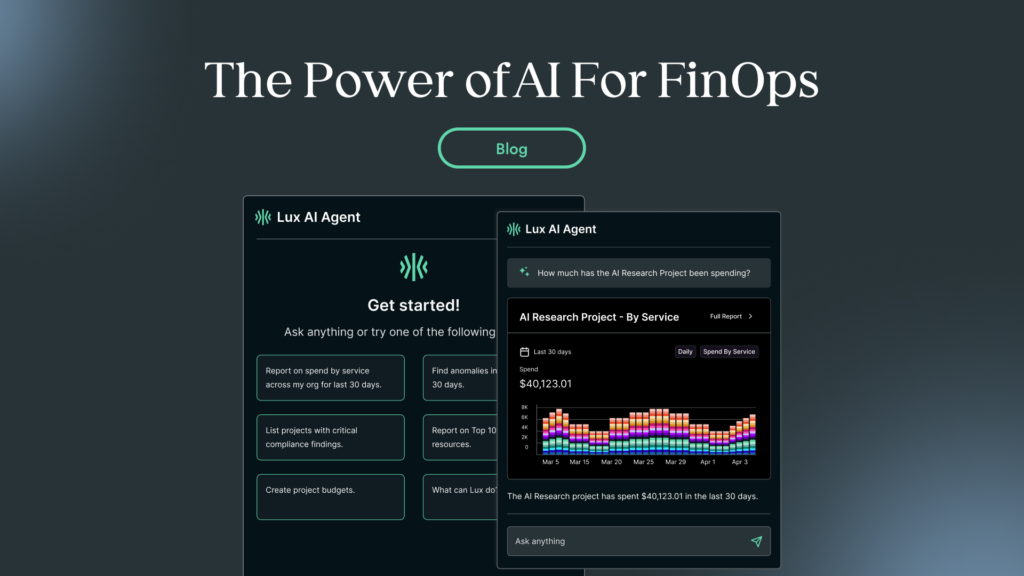
In our recent session, AI for FinOps: 3 Practical Use Cases to Get Started, we walked through how FinOps teams are applying AI today to improve visibility, reduce manual effort, and strengthen governance, then demoed each workflow live inside Lux, Kion’s in-app AI agent.
Here’s what AI for FinOps actually looks like in practice.
What Is AI for FinOps?
AI for FinOps refers to using artificial intelligence to improve how FinOps teams analyze cloud spend, automate workflows, and enforce governance.
It’s different from “FinOps for AI,” which focuses on managing AI-related spend. AI for FinOps focuses on improving how FinOps teams operate.
Today, that impact typically falls into three categories:
- Guidance – Making cost visibility easier and more accessible
- Operational Efficiency – Reducing manual reporting and repetitive tasks
- Governance Automation – Accelerating guardrails and policy enforcement
During the webinar, we explored each of these with real examples and the key message was clear: AI isn’t replacing FinOps expertise, but it is amplifying it and making it more accessible to a wider set of roles across the organization.
The 3 Practical AI Use Cases in FinOps
1. AI for FinOps Guidance: Faster Answers, Broader Adoption
Many organizations rely on one or two FinOps experts to interpret dashboards and explain cost changes. That model doesn’t scale.
AI changes that dynamic and lowers the barrier.
In the session, we demonstrated how natural-language prompts can:
- Explain why cloud costs increased month-over-month
- Highlight top services driving spend
- Summarize trends and recommend next steps
- Help new or adjacent stakeholders (finance, accounting) self-serve insights
Why this matters:
- Faster onboarding for early-stage FinOps teams
- Reduced dependency on experts
- Improved FinOps culture across engineering and finance
- Clearer understanding of cost drivers
AI-driven guidance isn’t about replacing expertise, it’s about making cost intelligence accessible.
2. AI for FinOps Operational Efficiency: Turning Repetition Into Automation
This is where most teams start seeing measurable ROI.
FinOps practitioners often spend hours on:
- Budget-to-forecast updates
- Leadership reporting
- Ad hoc spend breakdowns
- Anomaly investigations
In the live demos, we showed how AI can:
- Generate cost-per-customer trend analysis, or “unit economics,” by combining cloud spend and business data
- Create interactive reports within minutes
- Produce daily digests of anomalies, budget overruns, and compliance findings
- Reduce 60–90 minute manual workflows to just a few minutes
The theme here isn’t novelty, rather it’s friction reduction.
AI becomes valuable when it removes repetitive, manual effort without adding complexity.
3. AI for FinOps Governance: Scaling Guardrails Without Scaling Overhead
The most advanced (and strategically powerful) use case is governance automation.
During the session, we demonstrated workflows such as:
- Creating daily spend threshold alerts for AI projects, showing FinOps for AI in-action
- Restricting service usage after monthly budget caps are reached
- Generating cleanup policies for unattached cloud resources
- Translating governance intent into enforceable policy code
These workflows were human-in-the-loop approval-based and transparent, ensuring control remains with the team. The balance of automation with control is what truly makes AI viable in mature FinOps environments.
Why governance automation matters:
- Faster policy implementation
- Standardized guardrails across environments
- Reduced technical barrier to writing policies
- Proactive waste prevention
Governance is where AI shifts from convenience to long-term operational leverage.
Why AI for FinOps Is Accelerating Now
At the beginning of the webinar, we asked attendees whether they were using AI for FinOps. A majority said they were not yet using it, but among those who were, most reported meaningful results.
That split reflects the broader market:
- Interest is high
- Adoption is uneven
- Early adopters are already gaining operational efficiency
AI is no longer theoretical in FinOps. It is becoming expected both in managing AI spend and in using AI to accelerate operations. The question should no longer be “Should we explore AI” but rather “Where can AI reduce friction in our existing workflows?”
How to Get Started With AI for FinOps
If you’re evaluating AI for FinOps, start with one workflow tied to one pillar:
Start with Guidance if:
- Cost visibility is limited
- Stakeholders rely heavily on FinOps experts
Start with Efficiency if:
- Reporting is manual and repetitive
- Executive requests consume too much time
Start with Governance if:
- Waste recurs frequently
- Policies are slow to implement
- Guardrails are inconsistent
Small, measurable wins build momentum.
Watch the Full AI for FinOps Session
If you’d like to see these workflows in action including live demos of guidance, efficiency, and governance automation, the full session is now available on demand.
Or, if you want to explore how AI-driven FinOps could work in your environment:
FAQ: AI for FinOps
What is AI for FinOps?
AI for FinOps is the use of artificial intelligence to improve cloud cost visibility, automate reporting and analysis, and strengthen governance through policy and guardrails.
Is AI replacing FinOps practitioners?
No. AI acts as a multiplier, accelerating workflows and surfacing insights while human oversight remains essential.
What are practical AI use cases in FinOps?
The most common use cases are:
- Natural-language cost analysis
- Automated reporting and forecasting
- Spend threshold alerts
- AI-assisted policy creation
- Governance automation
What’s the difference between FinOps for AI and AI for FinOps?
- FinOps for AI focuses on managing AI-related spend.
- AI for FinOps focuses on improving how FinOps teams operate.
How Much Data Do You Need for AI-Driven Forecasting?
While longer history improves accuracy, meaningful directional forecasts can often be generated using:
- A few months of spend data
- Custom run-rate windows (e.g., 14–30 days)
- Adjustable forecasting assumptions
AI forecasting works best when it complements, not replaces, financial judgment.