

Featuring Tatum Tummins at FinOps X 2026
Artificial intelligence is creating enormous opportunities for enterprises, but it is also introducing a new category of technology spend that many organizations struggle to understand and manage.
Leaders are being asked to justify AI investments, demonstrate business value, and establish governance controls all while enabling teams to innovate quickly. Yet many organizations still cannot answer fundamental questions: Which teams are driving AI costs? What value are those investments generating? Why did spending suddenly increase?
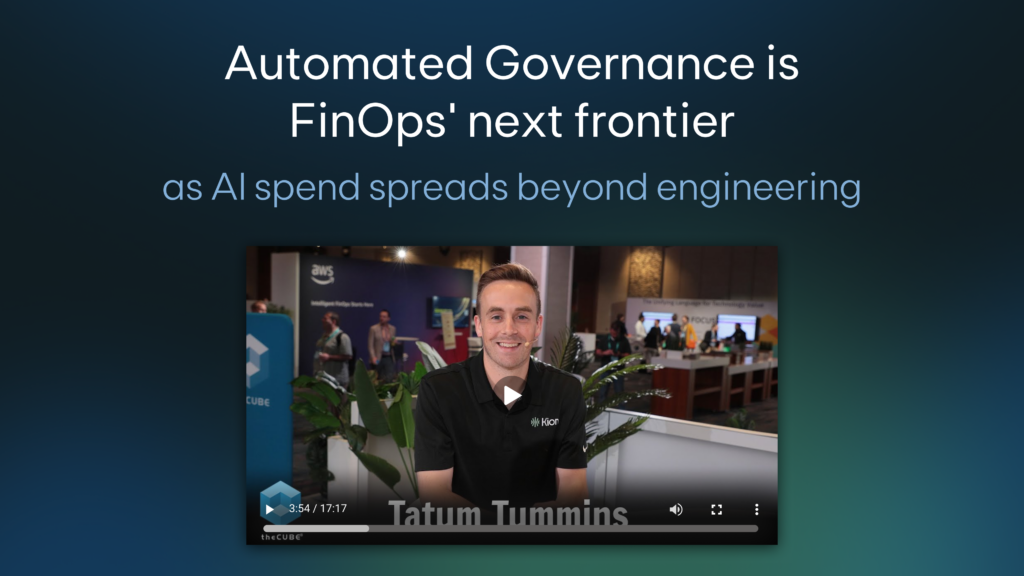
In this interview from FinOps X 2026, Kion Senior Product Manager Tatum Tummins joins theCUBE to discuss how organizations can apply proven FinOps principles to AI. Drawing on lessons learned from cloud adoption, Tatum explains why visibility is the foundation of effective AI token cost management, how governance can enable rather than restrict innovation, and why FinOps practitioners are becoming strategic partners in enterprise technology decision-making.
Watch the full conversation to learn how organizations can build the visibility, accountability, and governance needed to scale AI adoption with confidence.
Key Takeaways
Visibility Comes First
Before organizations can optimize or govern AI token spending, they need visibility into where costs originate and who is consuming resources.
Governance Should Enable Innovation
Effective governance is not about limiting experimentation. Organizations should create guardrails that allow teams to innovate while preventing unexpected costs and risk.
AI Spend Is No Longer Just an Engineering Concern
As AI adoption expands across business functions, technology spending increasingly involves non-technical users, executives, and line-of-business teams.
FinOps Is Becoming a Strategic Business Discipline
The role of FinOps is evolving beyond reporting and forecasting to helping organizations align technology investments with business outcomes.
Full Transcript:
[John Furrier] >> Welcome back to theCUBE’s live stream here in San Diego, FinOps X 2026. I’m John Furrier, host of theCUBE, my co- host Paul Nashawaty with theCUBE Research. A lot of practitioners, a lot of customers are trying to figure out how to do FinOps in the AI world while maintaining their current environment. Tatum Tummins is here, senior product manager at Kion, does FinOps among other things. Tatum, thanks for coming on theCUBE. Appreciate it. Good to see you.
[Tatum Tummins] >> Yeah, thanks for having me. Thank you guys for still having energy for me. I’m trying to bring the same energy to you all. I know we’re all tired. It’s been a long couple days.
[John Furrier] >> It’s going to be standing up a lot. We’re sitting down talking. But again, very active show. I want to ask you because a lot of feedback we’ve been getting from people in the hallway track is, ” I love all this new stuff, but I got to just get the job done, continue to do the FinOps job, as well as understand and get my hands around what’s going on in AI. I don’t need to boil over the ocean. I just got to lock down what’s going on and kind of bring them together. ” What’s your reaction to that?
[Tatum Tummins] >> I will say, I think the opening keynote here, exciting stuff, and clearly where the world’s headed. There is a little bit of folks still walking around, but I’m not quite ready for that. I’m still trying to figure out the cloud stuff and the SaaS stuff. I’m not even quite ready for the AI stuff yet, but it’s been good to get the conversation going. I say what I’m really excited about is I feel like everybody here is leaving with a sense of urgency of, ” If I don’t have visibility into every dollar in my technology organization, that’s priority one. ” And that’s great. We need folks to figure out a plan. Internal, external, whatever your tooling of choice is, you got to figure out a way to get visibility into everything because that is what kind of catapults everything off of that, optimization, governance. And so I’m glad the AI talk track is really ramped up. I know some folks are a little not there yet, but they’re going to be there.
[Paul Nashawaty] >> Tatum, it’s always great to talk to you. We’ve been having these discussions for many times. I think this is awesome, but something that’s new here and you kind of just touched on it, and I don’t want to gloss over it because I think it’s important, is what we’re talking about here is new to some people. Some people just look at this and go, ” Wow, this is exciting. ” And that’s why they’re here is because this is all new, exciting stuff for them to figure stuff out. But to your point, your point is very valid. Some people are looking at this going, ” Hey, I’m still trying to figure out just basics of cost optimization. ” That’s what the FinOps piece is, right?
[Tatum Tummins] >> Yeah.
[Paul Nashawaty] >> And a lot of what they’re looking at today on the show floor and in the keynotes and such, they’re not going to be implementing for the next year or two maybe, but now it’s going to move fast because it’s AI, of course. But let’s talk a little bit about that. What does that mean for the practitioners and for the buyers that are trying to get here?
[Tatum Tummins] >> Well, it means they have to be thinking about what the next two years means and they need to find, from a tooling perspective, you’ve got to find a tool that you can grow with. You’ve got to find something that meets your needs today, but something that as you think long term, ” All right, today I need visibility. What happens when I need governance? I may not need governance today, but in six months, a year from now, I need a tool that’s going to help me do governance. ” And so it’s good that folks are starting to frame that way and starting to think about like, ” What does my business look like in a year and what am I going to need to be successful? ” I’ll give you an example. We’ve got a customer that is just now kind of getting to that stage where they can see their Anthropic spin, they can see it by individual engineer. That’s all very exciting. Next step for them, where they’re interested in going is, ” Hey, we want to give every engineer a sandbox. We’re going To give them 500 bucks. They can play around, they can do whatever innovation they want. ” And then when that gets triggered, Kion’s tool decommissions that account. They get to do their use case and they go pitch what they learned, what they built, if it’s valuable, and then they can make business decisions on, ” All right, this test case, this POC, did that drive anything or onto the next? “
[Paul Nashawaty] >> But is this going to change the model? See, I think you’re onto something really, really important here. This is going to change the overall business model. So with these initiatives that are being built, there’s business outcomes. So there’s direct ROI for what the spend is. That makes sense. But the innovation piece is also driving for experimentation and how it comes together. If that doesn’t happen, then you can’t drive towards business outcomes. So I think that the sandbox idea is fantastic. It’s a good step towing the water type of thing. However, I think that that should be general practice and moving forward as an overall. What are your thoughts?
[Tatum Tummins] >> You’ve got to let folks have a playground but put a fence around the playground, right?
[Paul Nashawaty] >> Right.
[Tatum Tummins] >> And that’s like the whole exciting part of all this journey is like the art of the possible, but it’s also possible to spend millions of dollars in the spend.
[Paul Nashawaty] >> Absolutely.
[Tatum Tummins] >> And so the other thing that I think is interesting is the folks that start to think about those guardrails and governance now are the folks that are not going to get so jaded that they tell everybody to put down their AI tokens, because this happened in the cloud. When I was starting out my career, someone migrates to the cloud. All of a sudden the business cases, they’re spending way more than they ever thought. CFO freaks out, ” We shouldn’t go to the cloud anymore. ” We’re going to start to see that again where AI is going to have a spike and say, ” I think it’s bad. “
[John Furrier] >> Yeah. So you’re saying pullback’s bad?
[Tatum Tummins] >> Yeah. I’m saying that you have that spike, that anomaly, and all of a sudden the CFO’s like, ” Nevermind, no more licenses for anybody. ” If you start to think about governance at the beginning and you’ve got some safety guardrails around, you don’t have that freakout moment where you’re like, ” Nevermind, no more AI. “
[John Furrier] >> Talk about the governance, because I think this is where you guys could shine as a company. And this is also where we’re seeing the agentic piece kicking in because coding, great use case, opening up the enterprise, seeing a lot of that. But now the governance is tied and we’re hearing here more data sets. So data sets are coming in fast. We don’t know what’s next. So data sets, governance, it rhymes. It sounds like we’re in the data engineering business, but it’s really not. Take your thoughts on the governance and what you guys are doing and what that role plays.
[Tatum Tummins] >> Yeah. So for us, Kion’s a self- hosted solution and so that’s kind of unique, especially being in here. We’re not SaaS, means we deployed in your AWS, Azure account, whatever you prefer. What that allows us to do is we have a lot of hooks into AWS and Azure. And so for folks that are using AI through Bedrock, through Foundry, through Vertex, we can do real governance, whether it’s restricting certain instance types, GPUs that cost X per hour only, or actually doing those sandbox examples of allow folks to use up to a certain threshold and then put those caps and enforce that. So we have a really good story there and then directly with the providers, that’s still something we’re still exploring. We can bring that spend into Kion. Now, what can Kion do directly at that level? I think the other thing that’s interesting here, and I don’t know if you guys have had this conversation already, but it’s no longer a technical resource problem. This is your CIO and CFO might spend just as much money as your developers now, right?
[Paul Nashawaty] >> Yeah.
[Tatum Tummins] >> Just because as they’re learning and playing with AI and having a great time, they’ve never had to think about what I’m spending up or what I’m… Engineers, we’ve spent two decades getting them to a place where they’re at least a little more cost- aware. They know when they spend up a VM, it costs money. Our sales guy, he doesn’t even think about the prompts that he’s putting in anymore.
[John Furrier] >> He just loves the results.
[Tatum Tummins] >> Well, I tell you, we had an internal hackathon at Kion. We gave everybody a week to just kind of test out some use cases. We had a sales guy spent more money than anybody on the development team. True story.
[John Furrier] >> It’s a sales guy.
[Tatum Tummins] >> Yeah. And he didn’t mean to. He was asking a bunch of prompts and asking for a bunch of data sets and pulling in things through MCP. And next thing you know, he spent 700 bucks he didn’t even mean to.
[John Furrier] >> But that’s the use case that these AI builders aren’t just engineers. This is the shadow AI game you’re seeing.
[Tatum Tummins] >> Yes.
[John Furrier] >> And I was talking to some CFOs doing some research on CFOs specifically and the trend is to what you guys are doing, sandboxing kind of generically, but meaning here, let’s get a controlled environment, bake out essentially the old school thinking would be do a prototype and then sell it to get funding. This is kind of the same pattern. Wow, this is really good. Then you scope it, then they can budget for it. Then it’s much more confident. They’re not like a black box.
[Tatum Tummins] >> I’m going to steal that, that idea of like you almost internally, you build your POC and then you pitch it internally of like, ” Now this is worth our funding, this is worth going to production with, ” and you can kind of sell yourself. And that way too, you know what theoretical value you should be measuring. If you have people building agentic workflows and sending off agents across your company and you have no idea the purpose of any of them, they’re not labeled with what you’re actually trying to accomplish, how do you even know what you’re getting at?
[John Furrier] >> When you’re in creative mode, there’s no downside. You want to discover and explore, but you can go off the rails pretty fast.
[Paul Nashawaty] >> Well, it’s actually even more important. I think I want to touch on what you were talking about. When you put controls, you’re right, this is a boardroom conversation. This isn’t just a technical conversation. This isn’t a practitioner. This is happening at the C- level. We know that because of the financial controls. The minute you start putting controls in place, it’s a slippery slope because now it’s like, ” Okay, well, you spent a lot of money, okay, but if you cut off the innovation, now you’re at risk of being competitively at a disadvantage. ” It’s almost like, ” Well, you don’t want to drive without car insurance because you’re worried about not yourself, but other people. ” And that’s kind of the same thing here. It’s like, ” If I don’t want to stop spending because if I stop, then I’m going to be competitively boxed out. “
[Tatum Tummins] >> And I think to that point, we need to make sure that we don’t give AI governance kind of a bad rep here because governance doesn’t mean your hand gets slapped when you try to do anything.
[Paul Nashawaty] >> Right. It just means boundaries. Yeah.
[Tatum Tummins] >> What it should mean, and I’ll give you how I would think about it is if I’m an organization looking to implement this, I would want to set a soft cap. And what I mean by soft cap is when engineer Y hits a token threshold, I want to know about it and then I have the decision as that VP of engineering or whatever, do I want to, ” Hey, keep going? ” Or do I want to say, ” Hey, I want to actually talk about what we’ve done here. Are we getting any value from it? ” And then you proceed, but you just have to have some checks and balances. It doesn’t mean innovation but within your $1, 000, it means innovation, but we’re all kind of a part of the process as you’re learning, as we’re spending money and talking about what are we getting out of it.
[John Furrier] >> How has FinOps changed? Because our vision here is that this is going to be the community that’s going to be building fast. We saw that in cloud native, we saw it in CNCF, a lot of projects will be flying around and a lot of adjacencies coming together. How has the role changed? And two, how has the organizations changed for the customer? Because the stay- in- your- lane mentality, it’s not my department mentality is going to go away, which means there’s going to be cross- pollination, there’s going to be collaboration, and maybe consolidation of teams.
[Tatum Tummins] >> So before coming on the vendor side, I was a practitioner, large healthcare company here for seven, eight years, just like everybody else in this room that started out around the same time, they either were in finance or they were some random technologist, cloud cost was a problem, ” Hey, I’ll raise my hand, I’ll solve it. ” And all of a sudden you had FinOps practitioners, and they still were within finance, within the engineering group. Now, FinOps is a strategic business lever that organizations are using. That strategy piece of like, ” How should we think about our technology investments? ” Is the big change to me. It’s no longer trying to get a spend report and tell you about analysis or sending over a, ” Here’s our forecast. ” That should be automated at this point.
[John Furrier] >> Well, it’s a business model transformation, not an IT transformation project.
[Tatum Tummins] >> Yeah.
[John Furrier] >> So C- suite alignment, line of business alignment, engineering alignment. There’s a lot of alignment. So that skill, that makeup of that person isn’t yesterday’s FinOps.
[Tatum Tummins] >> It’s no longer like data analysis, it’s high- level strategy, what’s our AI strategy and how do we keep our value in mind? FinOps practitioners now are a part of some of the most important conversations that organizations are having and that’s a good change.
[Paul Nashawaty] >> Yeah. And, Tatum, we’ve had some conversations before this and in the briefings that we’ve had and discussions, I’d love to hear your experiences around where AI has meaningful impacts to FinOps outcomes. You had some use cases, some examples that you were sharing with me. I think that would be really relevant because it ties back to what John was talking about here.
[Tatum Tummins] >> Yeah. My favorite use case, I call it guidance, some call it usability, AI agents, AI chatbots within feature or within tools now. If you think about Joe and Sally in accounting who don’t know anything about FinOps, they’re new to it, but they have needs. They need to go get a chargeback report, whatever it may be. It can be daunting to hand them over a tool and say, ” Figure out how to use it. ” But now professionally, personally, we all know how to ask questions in ChatGPT or Claude, like it’s becoming a second nature. So when you embed AI into your tools, all of a sudden these folks who are now getting exposed to FinOps for the first time, they just ask a question, ” Hey, what’s my budget for this cost center? ” It creates this new level of usability that I’m so excited for. We’re already seeing customers tell us like, ” I’m getting people to log in and use the tool that I’ve been begging to use the tool for years, but, A, they have kind of fun with it, but also, B, it’s just easier for them to use it. ” And there’s obviously an efficiency play and there’s lots of things we get into there, but just like usability of getting people to actually collaborate and use the same tool because now it’s the same experience for everybody and I think that’s a really beautiful thing.
[John Furrier] >> What’s the coolest thing you see going on here at the show? Obviously a lot of new things, the tools are emerging, techniques, best practices. JR is very transparent on stage and saying, ” Here’s what we know. New KPIs are coming online every day. The community’s growing. ” What’s the big takeaway, highlight, walk- away message?
[Tatum Tummins] >> For me, I try to stay intelligent about AI the best I can, but every day I’m behind. I have thoroughly enjoyed, we saw some of it on the big stage and then some of it you just had through conversations, how people are approaching the optimization of AI, some of it very technical, some of it just common sense, like starting to kind of get an understanding of, ” Hey, do I really need to have a cache that’s got all this memory when I’m just asking about the weather? ” Little things like that. I’ve really enjoyed kind of those insights of some beginning stages of optimization strategy, which by next year there’s going to be a whole playbook on that, but right now it’s still early and experimental.
[Paul Nashawaty] >> Oh, I want to ask that. I can’t leave that on the table. By next year, what’s going to happen by next year? What’s going to happen with Kion? What’s going to happen with FinOps? What’s happening?
[Tatum Tummins] >> Well, by next year, I guess the logo’s going to be gone.
[Paul Nashawaty] >> The logo’s gone. That’s true.
[Tatum Tummins] >> But yeah, I’ll tell you what next year’s going to look like for us and I’m sure there’s other folks here that are going to follow similar, it is the AI governance story, making that as easy as possible to implement, easy as possible, human in the loop, approval, workflow, being able to make decisions. I mean, the visibility piece, I just feel like that’s kind of simple now. I can go in our MCP server, combine three data sets and say, ” Hey, tell me this or that, and send a PDF to a boss. ” That stuff is whatever. But how do you actually put controls directly with Anthropic, directly with OpenAI, within Bedrock, within Foundry, to make people be able to scale comfortably? I think that’s where the need is going to be. I just really, really do.
[John Furrier] >> You guys really have a great business. I love where you’re positioned. Take a moment to put a plug in for Kion because the cloud and AI are coming together. The learnings from the cloud have come over. What are some of the things that people are watching? Why should they work with you guys? What signals in their environment would tell them to call you? No one really calls anymore, but to get engaged and how do they engage?
[Tatum Tummins] >> Sure, sure. Yeah. So I mentioned at the beginning, Kion’s self- hosted. So we actually deploy for your regulated enterprises, folks who have pretty strict security guidelines. We’re a great way to be able to lean into that type of automation pretty safely, right?
[Paul Nashawaty] >> Yep.
[Tatum Tummins] >> And then we’re built on three things. I call them kind of our core principles. Automated governance across cloud, across AI, AI- driven, using an agent, using AI within the platform. And lastly, doing that also beyond cloud, doing that across your SaaS tools, visualizing your on- prem spend. If those are three things that are interesting to you, Kion might be the tool for you, but that self- hosted governance angle is really where we’re different than the other folks in this room.
[John Furrier] >> Well, we’ll be tracking you guys, love the position. This is going to be a fast- growing market for all the changes we discussed. This community will be building out the platforms, the tools, the best practices, and it’s going to feed right up to the C- suite. It’s going to be at all layers of the organization. The money’s on the table. Revenue is being generated by AI, cloud scale, distributed computing. It’s the perfect storm of innovation. Thanks for coming on. I really appreciate it.
[Paul Nashawaty] >> Thanks, Tatum.
[Tatum Tummins] >> Yeah, thank guys for having me. Bye.
[John Furrier] >> I’m John Furrier, Paul Nashawaty, breaking down the future as it unfolds, you’re going to see value creation, cost understanding, and then value extraction coming, that’s going to create a whole new profit, loss, projections for all these companies. And it’s just getting started right here, here at FinOps, and of course theCUBE doing our part to share that with you. Thanks for watching.