What the first State of Tokenomics report reveals about how enterprises are managing, measuring, and proving the value of AI spend.
Enterprise AI has moved well beyond experimentation, but the financial practices surrounding it haven’t caught up.
That’s one of the clearest takeaways from the first State of Tokenomics report, published by the Tokenomics Foundation, a Linux Foundation project. Based on responses from 472 organizations across 11 industries, the report offers an early benchmark for how enterprises are managing the economics of AI at scale.
And one finding stands out: the biggest challenge isn’t necessarily how much organizations are spending on AI. It’s understanding what they’re getting for that spend.
Forty-three percent of respondents named proving value or ROI as a top Tokenomics challenge. Another 27% pointed to visibility and attribution of spend. Cost and pricing complexity? Just 7%.
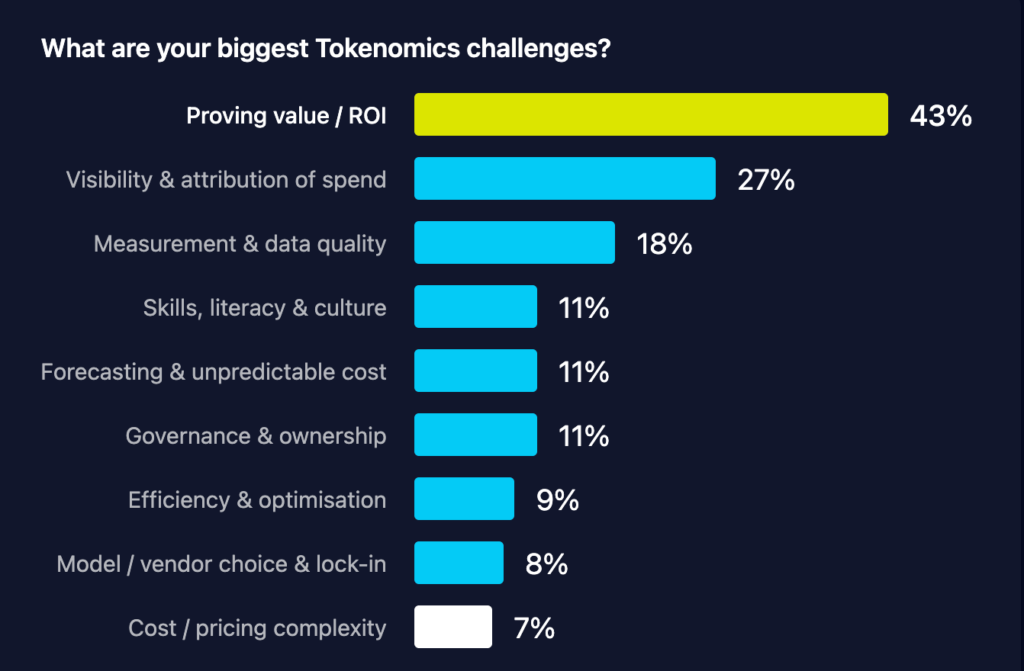
That gap between AI consumption and measurable value shows up throughout the report, from the models enterprises plan to use to who owns AI economics and what organizations are asking providers to give them.
As a founding member of the Tokenomics Foundation, Kion is helping contribute to the definitions and requirements around these emerging practices. Here are five findings from the report that stood out to us and what we think they mean for the future of FinOps for AI.
1. The future of enterprise AI is multi-model
Frontier models aren’t going anywhere. But enterprises don’t expect to rely on them as heavily.
Today, 51% of organizations surveyed describe their model usage as heavily weighted toward frontier models, scoring themselves an 8–10 on the report’s frontier-to-open-weight scale. Only 24% expect to remain in that range next year. The organizations relying most heavily on frontier models today also anticipate the biggest change, projecting an average decline of 2.7 points on that scale (source).
This doesn’t necessarily mean enterprises are abandoning frontier models. Instead, it points toward greater diversification in how organizations choose and consume AI.
That creates a new challenge for FinOps teams. Managing AI economics will increasingly mean understanding cost, usage, performance, and value across multiple models, providers, and environments rather than optimizing a single AI bill.
The future isn’t one model. It’s choosing the right model for the right workload.
2. AI spend visibility isn’t the same as proving AI value
Knowing what you’re spending on AI is important. Knowing what that investment is producing is something different.
The State of Tokenomics report found that 39% of organizations aren’t confident they can connect their AI spend to a business outcome their CFO would accept.
The relationship with spend visibility is particularly telling. Among organizations reporting only moderate confidence in their AI spend visibility, 60% couldn’t demonstrate CFO-acceptable value. Among organizations with highly confident visibility, that figure fell to 25% (source).
Visibility matters, but it’s only the starting point.
As organizations mature their FinOps for AI practices, they need to move beyond “What did we spend?” toward “What did that spend produce?” A practical framework for managing AI token spend starts with visibility and attribution, then builds toward connecting those investments to measurable outcomes.
That attribution can get more complicated when AI costs are shared across teams or projects. Allocating shared AI costs based on who is consuming or benefiting from those resources is another piece of understanding the true economics of AI.
But better data should also lead to better action. As organizations learn which AI investments are creating value and which aren’t, budgets and guardrails can help teams respond to those signals before spend continues unchecked.
A cost dashboard can tell you what’s happening, but it can’t tell you whether an AI investment is worth continuing.
Visibility tells you what AI costs. Value measurement helps determine what to do about it.
3. Someone needs to own the economics of AI
Who should own Tokenomics?
The State of Tokenomics report doesn’t point to one universal answer. Technology leadership is currently the most common owner, with 35% naming the CTO, CIO, or technology function, while 26% describe ownership as shared across functions.
But the more interesting finding may not be where Tokenomics sits. It’s that someone owns it.
Eighty-eight percent of organizations surveyed already have defined ownership of Tokenomics. Those organizations were 3.7 times more likely to report being able to demonstrate value to the CFO.
Among the 12% without defined ownership, none reported being able to connect AI spend to a CFO-acceptable outcome.
That doesn’t prove that assigning an owner causes better financial outcomes, but it does reinforce the importance of accountability as AI adoption expands.
As token-based AI consumption spreads across the organization, managing its economics becomes a company-wide responsibility rather than a purely technical one. Engineering may understand model usage. Finance may understand the economics. Business teams understand the outcomes they’re trying to create.
An effective Tokenomics practice needs to connect those perspectives while making accountability clear.
Tokenomics can be cross-functional, but accountability can’t be ambiguous.
4. Model routing is becoming part of the AI economics stack
As enterprises diversify their AI environments, model routing is quickly becoming part of the conversation.
A model router directs AI requests to different models based on factors such as cost, performance, latency, or workload requirements.
According to the report, 86% of organizations are either evaluating or already using a model router. Organizations using routers were also four times more likely to report being able to demonstrate CFO-level value from their AI spend.
The report shows an association rather than proving that routing causes better financial outcomes, but the trend reflects an important shift in how enterprises are thinking about AI consumption.
Not every workload needs the same model.
A simple summarization task and a complex reasoning workload may have very different requirements. As organizations use more models, routing provides a way to make those choices intentionally rather than defaulting every request to the same option.
Model selection is becoming an economic decision as much as a technical one.
5. Enterprises want transparency, standards, and guardrails, not simply cheaper AI
One of the most telling findings in the report may be what enterprises say they want from AI providers.
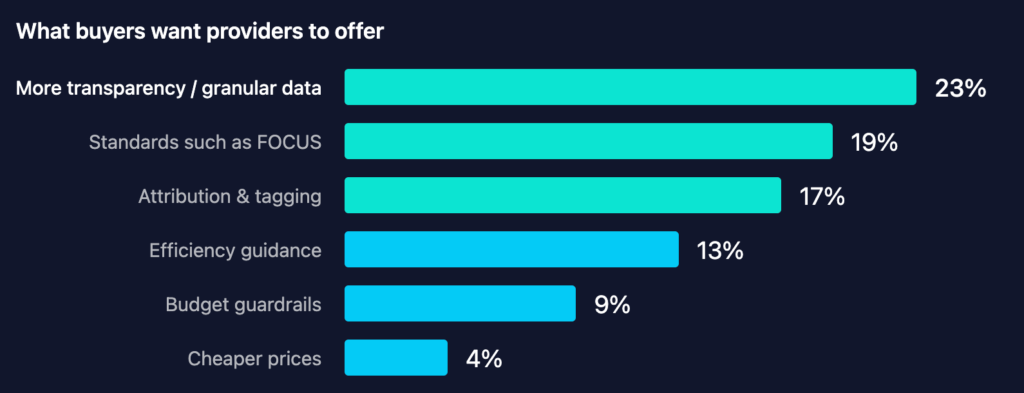
When respondents were asked what providers could do to make Tokenomics easier, 23% asked for greater transparency and more granular usage data. Other top requests included standards such as FOCUS, better attribution and tagging, efficiency guidance, and budget guardrails, which ranked among the top 5 responses at 9%.
Only 4% asked for cheaper pricing. That distinction matters.
Enterprises aren’t only looking for better visibility into AI consumption. They’re also looking for the structures needed to manage that consumption: standardized data, clearer attribution, guidance on efficiency, and guardrails that can help keep usage within defined financial boundaries.
Budget guardrails are especially notable because they represent a shift from simply observing AI spend to actively governing it. Once teams can see and attribute consumption, budgets and other controls can help them establish boundaries around that usage without requiring every decision to become a manual approval.
There’s another interesting signal in the responses: 7% of respondents independently mentioned FOCUS, the open billing data standard already being adopted across cloud providers, in free-text responses without being prompted about it.
That suggests practitioners are already thinking about AI cost data through a lens familiar to FinOps: standardized, granular information that can be consistently attributed, analyzed, governed, and acted on.
Enterprises aren’t simply asking for cheaper AI. They’re asking for the visibility and guardrails to manage it.
What the State of Tokenomics Means for FinOps for AI
Taken together, these five findings point toward an AI economy that is becoming more complex, distributed, and accountable.
Organizations aren’t simply looking for ways to spend less on AI. They need to understand where AI spend is going, what it’s producing, and when to scale, optimize, or stop an investment.
That requires moving beyond basic cost visibility. Organizations need to attribute AI consumption to the teams and use cases driving it, connect that spend to measurable outcomes, and establish guardrails that can act on what the data is telling them.
As AI usage expands across models, providers, and teams, those capabilities become even more important. Knowing the total AI bill at the end of the month isn’t enough. Teams need the context to understand what drove that spend and whether it created value, and the controls to respond when usage or outcomes move outside the boundaries they’ve established.The goal isn’t simply cheaper AI. It’s making every AI investment count.
The first State of Tokenomics report gives us an early benchmark for where enterprise AI economics stands today. It also points toward what’s needed next: better attribution, clearer measures of value, and governance that helps organizations act on those signals as AI consumption scales.
[Read the full State of Tokenomics report from the Tokenomics Foundation.]
Put FinOps for AI Into Practice
Want a closer look at how organizations can apply these practices? Kion’s FinOps for AI guide explores how to bring visibility, attribution, cost controls, and guardrails to AI spend across models and providers.
Frequently Asked Questions
What is tokenomics in enterprise AI?
Tokenomics is the practice of understanding and managing the economics of AI consumption. It includes tracking AI usage and costs, attributing spend to teams and workloads, evaluating model economics, establishing financial guardrails, and connecting AI investments to measurable business outcomes.
What is the State of Tokenomics report?
The State of Tokenomics report is research published by the Tokenomics Foundation examining how enterprises manage the economics of AI. The first report surveyed 472 organizations across 11 industries and explored areas including AI spend visibility, value measurement, model usage, model routing, organizational ownership, and provider transparency.
What are the biggest challenges with enterprise AI spend?
According to the State of Tokenomics report, proving value or ROI was the most commonly cited Tokenomics challenge, identified by 43% of respondents. Visibility and spend attribution followed at 27%, while 7% identified cost or pricing complexity.
What is model routing?
Model routing is the practice of directing AI requests to different models based on factors such as cost, performance, latency, or workload requirements. It can help organizations make more intentional decisions about which models are appropriate for different AI use cases.
How can organizations measure the value of AI spend?
Measuring AI value requires going beyond total cost or token consumption. Organizations need to attribute AI spend to specific teams, applications, workloads, or use cases and connect that investment to relevant outcomes, such as productivity improvements, revenue, completed work, or other business metrics. The appropriate outcome will vary by AI use case.
Does better visibility into AI spend prove ROI?
No. The report distinguishes knowing what AI costs from showing a business outcome a CFO would accept. A cost dashboard helps, but teams also need a way to measure the value produced.
Does the report show that model routing improves financial results?
It shows an association: organizations using model routers were more likely to report CFO-level value. The survey does not establish that routing caused that result.